Facing a Raise on the River, Should KQ Bluff Catch? - 1/3 Hand Analysis
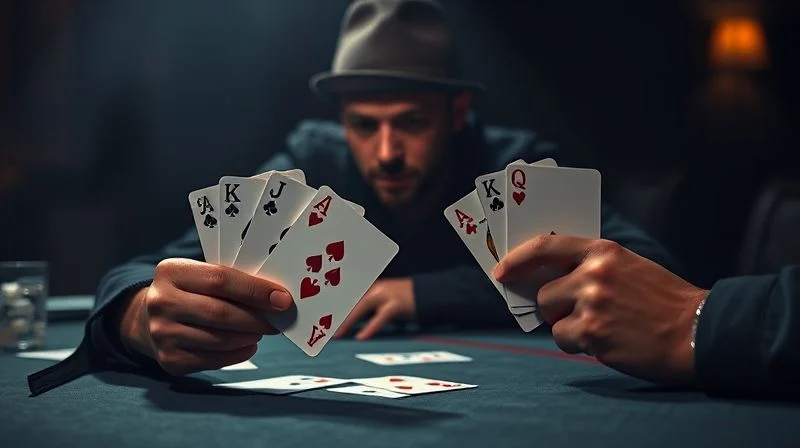
A Reddit user shares a 1/3 cash game hand: Hero in BB calls with KQo, flop J-K-6 checks, turn bets 15, river bets 15 then faces a raise to 50. Should Hero call? This article analyzes opponent's range and Hero's decision.
Hand Review
This is a hand from a 1/3 No-Limit Hold'em cash game with effective stacks of about $300.
Preflop: UTG+2 (villain) raises to $10, folds around to Hero in the big blind with KQo, who calls.
Flop: J♣ K♦ 6♠ (rainbow board). Hero checks, villain checks.
Turn: 7x (exact suit unknown). Hero bets $15, villain calls.
River: 8x. Hero bets $15 again, villain raises to $50. Pot is $115, Hero needs to call $50. Hero faces a decision.
Decision Analysis
Hero has top pair top kicker (KQo), but the river 8 may complete some straights (e.g., T9 makes a straight, or JT/98 make two pair). Villain checked the flop, called the turn, and raised the river. His range could include:
- Value hands: JT, J8, K8, KJ, Q9 (straight), T9 (straight), 88, 77, 66, etc. Note that preflop UTG+2 raised, so some of these hands (e.g., KJ, 88) are within a normal range, but low suited connectors like T9, Q9 are also common among TAG players.
- Bluff hands: For example, A♣ 9♣, Q♣ 9♣, 9♣ 6♣ as busted draws, or pure air raises.
Since Hero's KQ only blocks KQ and KJ but not key draws like T9 or Q9, and Hero's small river bet ($15) may be interpreted as thin value or a blocker bet, this could induce a raise.
Recommendation
In low-stakes games, many players do not bluff-raise on the river, especially after Hero has bet both the turn and river. Villain's range skews toward value hands like KJ, JT, 88, T9, etc. Hero's KQ only beats a few bluffs and weaker Kx (like K9). Given pot odds (115:50, roughly 2.3:1), Hero needs about 30% equity to call.
Generally, on this board, Hero's KQ is better suited for a fold because the opponent's value range is wide while the bluffing range is insufficient. However, if Hero has a prior read (e.g., the opponent has bluffed frequently before), then a call can be considered.
Example: In a typical 1/3 cash game, most players' river raising ranges are value-heavy, so folding is the safe play.
Conclusion
Hero should fold unless there is clear evidence that villain has a very wide bluffing tendency.