Ailen Ji Rallies From Short Stack to Win Australian Poker Cup
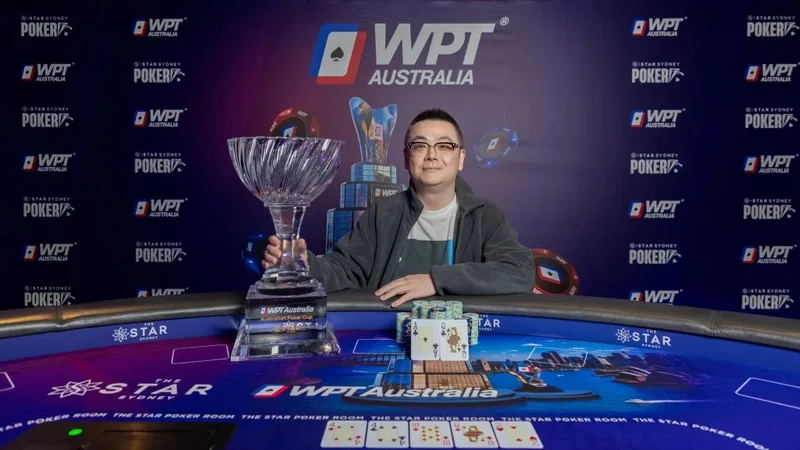
Ailen Ji came from a short stack at the final table to win the Australian Poker Cup, defeating Ross Coveney heads-up for 83,740 AUD and a WPT Prime Championship seat.
A Comeback Run in the Australian Poker Cup
Ailen Ji, a Chinese-Australian player, won the opening tournament of the WPT Australia 2026 festival, the Australian Poker Cup. Ji began the nine-handed final table as one of the shorter stacks, in seventh place, and worked a steady climb through the field before defeating Ireland's Ross Coveney in the final heads-up match.
The victory was worth 83,740 AUD (about 60,293 USD), a crystal trophy, and a ticket to the WPT Prime Championship in Las Vegas. The event carried a buy-in of 1,150 AUD and drew 441 entries, generating a prize pool of 441,000 AUD (roughly 317,520 USD). The top 56 finishers reached the money.
How the Final Table Unfolded
Ji's path from seventh in chips to the title was built on patience and one high-variance decision that shifted the balance of the table.
The pivotal moment came with four players remaining. On a board of A-J-6-2-5, Filip Radic moved all in as a bluff holding Q-10. Ji called with K-4, a hero call that stood up and sent him to the top of the chip counts. From there he held the chiplead into heads-up play.
In the final hand, Ji held A-Q against Coveney's J-J. A queen on the turn gave Ji the winning pair, ending the tournament.
Final Table Results
-
- Ailen Ji, Australia — 83,740 AUD (about 60,293 USD)
-
- Ross Coveney, Ireland — 53,000 AUD (about 38,160 USD)
-
- David Hirst, Australia — 39,000 AUD (about 28,080 USD)
-
- Filip Radic, Australia — 29,000 AUD (about 20,880 USD)
-
- Sam Pantos, Australia — 22,400 AUD (about 16,128 USD)
-
- Yoad Agmon, Australia — 17,000 AUD (about 12,240 USD)
-
- Gongli Li, Australia — 13,100 AUD (about 9,432 USD)
-
- Daniel Tolomeo, Australia — 10,200 AUD (about 7,344 USD)
-
- Matthew Maks, Australia — 8,700 AUD (about 6,264 USD)
What the Hero Call Teaches
The K-4 call on an A-J-6-2-5 board is the kind of spot that separates tournament winners from deep runs. In general terms, a hero call is a call made with a hand that beats only bluffs, usually when the caller's range is capped and the opponent's line looks polarized.
Several factors typically justify such a call:
- The opponent's story does not add up. On this runout, many value hands would have raised earlier or sized differently.
- Blockers matter. Holding a king or a four reduces some of the opponent's strongest holdings, making a bluff more likely.
- Pot odds set the bar. If the call risks less than the pot lays in return, the caller only needs to be right a fraction of the time to break even.
- Tournament dynamics can push a player toward aggression. With four left and significant pay jumps, an opponent may be incentivized to apply maximum pressure.
None of this makes a hero call correct by default. It is a high-variance play that depends on reads, timing, and the specific opponent. In this case, the read was right, and it turned a short stack into a chiplead.
Why the Result Matters
The Australian Poker Cup sits at the front of the WPT Australia schedule, and its 1,150 AUD buy-in makes it accessible to a wide field. A 441-entry turnout and a 441,000 AUD prize pool show the event's pull in the region.
For Ji, the win also carries a practical bonus: a seat in the WPT Prime Championship in Las Vegas, where he will test his form against a larger international field. For Coveney, the runner-up finish is a strong result in a fast, large-field event.
The Bigger Picture
Deep runs in low-to-mid buy-in tournaments often hinge on a handful of decisions rather than constant aggression. Ji's tournament followed that pattern: survive as a short stack, pick spots, and convert one well-timed call into a chip lead that could be defended.
That approach is a useful reminder for players at every level. Chip leads in the late stages are not just about having the most chips; they are about applying pressure while avoiding unnecessary confrontations. Ji's heads-up finish, sealed with A-Q against J-J, closed out a comeback that began with him near the bottom of the final table.
FAQ
- Ailen Ji, a Chinese-Australian player, won the event, defeating Ireland's Ross Coveney in heads-up play.