Can a $20 AI Replace a $500 Poker
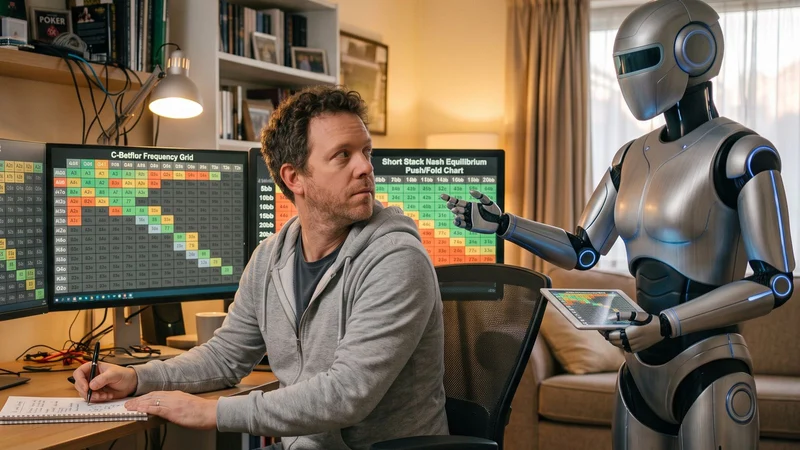
A look at whether low-cost AI tools can substitute for expensive poker mindset coaching, and where human coaching still holds an edge.
The Question Behind the Headline
Poker players have long paid premium rates for mindset coaching. Rates of several hundred dollars per hour are commonly cited in the industry, and for many players that cost is a real barrier. The rise of cheap AI tools has raised an obvious question: if a subscription costs around $20 a month, does it make sense to keep paying for a human coach?
The short answer is that the two serve different purposes. AI tools are good at some parts of the mindset problem and weak at others. Understanding the split matters more than picking a side.
What AI Does Well
Modern AI tools are strong at structure, repetition, and availability.
- They are always on. A player can talk through a bad session at 3 a.m. without scheduling anything.
- They are cheap and predictable in cost. A flat monthly fee is easier to budget than hourly sessions.
- They are good at frameworks. If a player wants to walk through a pre-session routine, a breathing exercise, or a set of questions to ask after a losing session, AI can deliver that consistently.
- They do not get tired of repetition. Players often need to hear the same principle many times before it sticks.
For players who mainly need reminders, checklists, and a place to vent, a low-cost tool can cover a lot of ground.
What AI Does Poorly
Mindset work in poker is not only about information. It is about behavior change under pressure, and that is where AI has clear limits.
- AI cannot see you. A coach notices when a player's shoulders tighten, when speech speeds up, or when a player is rationalizing. Text on a screen does not capture that.
- AI tends to agree. Language models are generally built to be helpful and agreeable, which is the opposite of what a player needs when they are avoiding a real leak.
- AI lacks accountability. A scheduled session with a person creates a commitment. An app does not.
- AI does not know your history. A coach who has worked with a player for months can connect a current downswing to patterns from a year ago.
A Typical Split
In practice, many players use both. A common pattern is to use a low-cost tool for daily maintenance and to reserve human coaching for deeper issues.
- Daily: routines, journaling prompts, tilt check-ins, hand-history reflection questions.
- Periodic: reviewing long-term patterns, addressing confidence or motivation problems, and working through major downswings.
This is a general pattern, not a rule. The right mix depends on stakes, bankroll, and how much of a player's problem is technical versus mental.
The Cost Comparison Is Not the Whole Story
The $20 versus $500 comparison is easy to make and easy to misread. The relevant question is not which is cheaper, but which produces results per dollar.
If a player's issue is that they have no routine and no structure, a cheap tool may deliver most of the value. If the issue is that they keep making the same emotional mistake in big pots despite knowing better, a tool that agrees with them is unlikely to fix it.
What to Watch For
Players evaluating AI mindset tools should be careful about a few things.
- Claims that a tool can replace coaching entirely are usually overstated.
- Advice that sounds confident is not the same as advice that is correct.
- Tools that never push back are comfortable but rarely useful for growth.
Bottom Line
A $20 AI tool can support a poker mindset routine, and for some players it may be enough. It is not a like-for-like replacement for a skilled human coach, because the core of mindset work is behavioral and relational, not informational. The most practical approach for most players is to use cheap tools for consistency and save human coaching for the problems that actually need a person.
FAQ
- Generally no. AI tools are useful for routines, reminders, and reflection prompts, but they cannot observe a player's behavior, hold them accountable, or push back the way a skilled human coach can.