Hayward Wins First WSOPC Ring in
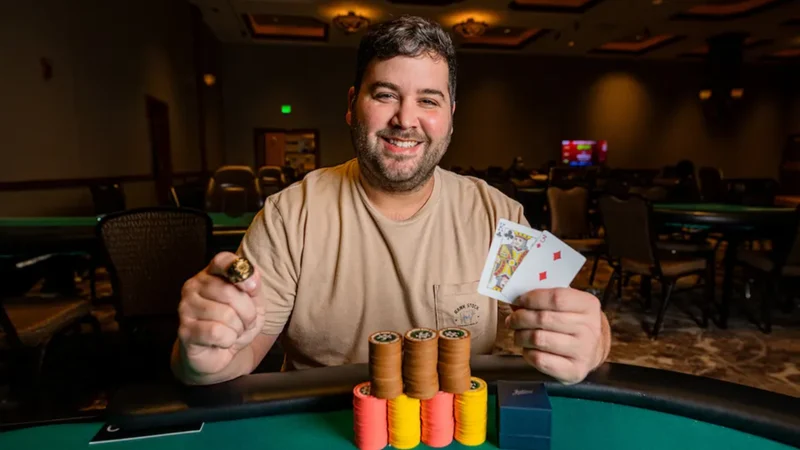
Connor Hayward, a cash-game specialist with about six months of tournament experience, won the $1,700 WSOP Circuit Main Event at Horseshoe Council Bluffs for $76,797 and his first gold ring.
From Cash Games to a Circuit Ring
Connor Hayward won the $1,700 Main Event at the WSOP Circuit stop at Horseshoe Council Bluffs, earning his first WSOPC gold ring and the largest score of his career at $76,797. The result is notable less for the money than for the path: Hayward is a long-time cash game specialist who spent roughly eight years playing cash games exclusively at Harrah's Kansas City before venturing into tournament poker about six months before this win.
The transition from cash games to multi-day tournaments is one of the more common adjustments players make, and it comes with a distinct set of demands. Cash game players are used to deep stacks, unlimited re-buys, and the freedom to leave a table at any time. Tournaments impose fixed starting stacks, escalating blinds, and payout structures that reward survival and laddering as much as chip accumulation. Hayward's run suggests the adjustment took hold quickly.
Tournament Format and Numbers
The Main Event drew 232 entries at a $1,700 buy-in, generating a prize pool of $351,480. The top 36 finishers were paid. The event ran in a two-day format, which is a relatively fast structure for a Circuit Main Event of this size and compresses the decision-making timeline considerably.
A two-day format typically means larger blind jumps and shorter levels than a three-day event, which pushes players toward more aggressive stack management. In practical terms, that means fewer opportunities to wait for premium hands and more situations where a player must commit chips with marginal holdings or risk being blinded down. For a player coming from cash games, where stack depth usually allows patient play, adapting to that pressure is often the hardest part of the switch.
Heads-Up Against an Experienced Opponent
Hayward's final opponent was John Ypma, an experienced tournament player who had already won a WSOPC ring earlier in the year. Ypma began heads-up play with roughly a 2:1 chip lead, a meaningful advantage in a format where blinds are already high relative to stack sizes.
Heads-up play is a distinct discipline. With only two players, hand values shift dramatically: many hands that are folds at a full table become profitable opens, and aggression frequency rises sharply. A 2:1 chip deficit is recoverable but leaves little room for error, since a single lost all-in can end the match. Hayward reversed the deficit and closed out the event.
On the final hand, Ypma moved all-in with Js Ts and Hayward called with Kc 3d. The board ran out 9s 5s 5d 3h 4d. Ypma's jack-high did not improve beyond a missed flush draw, while Hayward paired his three on the turn to secure the ring. It is a typical example of how a heads-up all-in confrontation can hinge on a single card, and why chip leads at that stage are never fully safe.
Final Table Results
-
- Connor Hayward (USA) — $76,797
-
- John Ypma (USA) — $50,593
-
- Matthew Riffel (USA) — $34,304
-
- Jake Flores (USA) — $23,961
-
- Nick Barksdale (USA) — $17,257
-
- Nicholas Stille (USA) — $12,828
-
- Robert Wilson (USA) — $9,852
-
- Kevin Berthelsen (USA) — $7,826
-
- Ryan Brown (USA) — $6,438
A Quick Rise on the Tournament Circuit
A week before this victory, Hayward finished third in the $700 Main Event at the RGPS Golden Expedition in Joplin. Two deep runs in consecutive weeks, in different series and at different buy-in levels, is a reasonable signal that the results are not purely a single hot streak, though short samples in tournament poker are notoriously unreliable and variance remains a large factor over any six-month stretch.
What the win does establish is a concrete milestone: a first WSOP Circuit ring, a career-best cash, and a result that moves a former cash-game regular into the tournament conversation at the regional Circuit level. Whether that translates into further deep runs is a question only future events will answer.
What the Result Illustrates
For players considering the same transition from cash games to tournaments, the event offers a few practical takeaways:
- Two-day structures reward early aggression and punish passive stack preservation, because blinds rise faster than in three-day events.
- Heads-up play requires a different opening range than full-ring play; waiting for strong hands is usually a losing approach.
- Short-term results in tournaments are noisy. A six-month sample, however impressive, says more about adaptation speed than about long-term edge.
The WSOP Circuit remains a regional proving ground where buy-ins are moderate relative to the WSOP summer series, and where a single good week can produce a career-defining result for a relatively new tournament player.
FAQ
- Hayward earned $76,797 for first place in the $1,700 Main Event, the largest score of his career to date.