David Yan: Why Empathy, Sleep, and an Open Mind Beat Solver Reliance
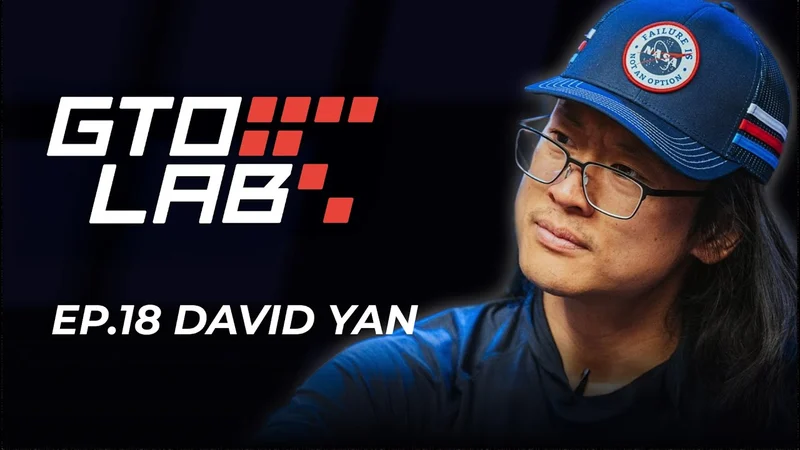
David Yan shares why understanding opponents, empathy, and life balance can give you a bigger edge than any solver.
David Yan: Why Empathy, Sleep, and an Open Mind Beat Solver Reliance
David Yan is not a player who fits neatly into a single category. He has navigated all online formats, endured the relentless grind, taken a break, and returned to live poker with a fresh perspective. In a recent interview, Yan opened up about how poker started as a hobby, gradually became serious, and how he found balance to keep it from consuming his life.
From Pokémon Cards to Supernova Elite
Yan's journey began in an unconventional yet classic way—through Pokémon cards. That community led him to people who eventually discovered poker. He started at the lowest stakes, playing small sit-and-go tournaments and micro cash games, then gradually explored more formats. He admits to mixing various formats for a long time, including 100BB Zoom, short stack, heads-up, sit-and-go, and tournaments. He achieved Supernova Elite status three times, and his online alias "MissOracle" earned respect among regulars.
After three years of grinding, Yan stepped away from poker for a while. It wasn't official or dramatic; he simply played less. Family and other priorities emerged. Unlike many, he didn't dive intensely into online poker during COVID-19. Instead, he returned to an old hobby—Pokémon cards. What seemed like a revisit of a teenage passion evolved into a local online Pokémon card shop, which became more than a full-time focus.
Eventually, he returned to tournaments and the live scene. When he attended EPT Barcelona after years away, he remembered what he loved about poker. A few good runs certainly helped, but more importantly, he regained the feeling that this was the environment he wanted to compete in again.
Freedom as a Gift That Changes Over Time
A significant portion of the conversation revolves around freedom. Yan explains that poker allowed him to travel the world nonstop after leaving university. Growing up in New Zealand, a small country, he hadn't traveled much before poker, so this was a huge change. He could go anywhere, play when he wanted, explore cities, communities, and people. He even recalls the moment he missed a flight to Australia and simply opened a world map and decided to spend a week in Iceland.
Today, his relationship with freedom has changed. With a family and two children, he can't just fly anywhere on a whim. He doesn't say this with regret but as someone who understands that freedom looks different at various life stages. It used to mean planes, hotels, tournaments, and zero commitments. Now it also means the ability to be at home, choosing trips that make sense, and not letting life revolve around a good cash game or the next high roller.
Why Are Players at the Table?
One of the best parts of the interview addresses a simple yet often underestimated concept: not all players at the table are there for the same reason as you. Yan emphasizes that at lower and mid-stakes buy-ins, one of the first tasks is understanding why a specific person is sitting there. Do they want a title? A mincash? To look like a good player? Or are they just there to enjoy a poker night?
Yan uses a word that sounds odd in poker but makes sense: empathy. It's about putting yourself in your opponent's shoes and understanding why they make the decisions they do. If someone doesn't bluff the river with a combo a regular would always use, it might not just be ignorance. They might not want to be caught bluffing. Maybe they're afraid of embarrassment. Maybe the result means something different to them than it does to you.
According to Yan, these layers separate a player who knows strategy from one who knows how to play against people. Yan reiterates that good players shouldn't dismiss others' decisions too quickly. It's easy in poker to say: "that's bad," "this player is bad," "that hand doesn't make sense." However, often it's more beneficial to ask why it happened. What was your opponent thinking? What did they see that you didn't? Could it be that their line has logic in another game model? And even if they're wrong, their mistake might be information you can use later.
Results Don't Tell the Whole Story
Yan has a very pragmatic view of luck and selection in the high-stakes arena. Direct variance—whether someone hit a big tournament or ran well—is perhaps a bit overrated. The best players might reach the top level anyway, albeit more slowly. More important is indirect luck: who you meet at the right time. Whether you bust your first bankroll and never return or find a foothold. Whether you grow up in a place where selling action is common or where backing is seen as weak.
The public loves a simple narrative: he won, so he was the best. But poker is more chaotic. One year, one tournament, or one session doesn't explain everything. Yan says many players outside the spotlight could earn more than the average Triton regular yet might not appear in stories fans follow.
Studying Isn't Just About the Solver
Yan's approach to studying is less dogmatic than some technically-oriented players. He doesn't hide that he learned a lot from solvers, but his main way of improving was often through playing, conversations, and reflecting on hands. He's not saying solvers aren't important. Rather, that there are multiple paths to better play. Some are measurable and reliable, others irregular but capable of big leaps.
He also adds things that are harder to sell in poker discussions: sleep, health, good food, mental well-being, game selection, bankroll management, recognizing your A-game, and knowing when to take breaks. According to him, all these contribute to expected value (EV), even if they don't fit easily into a graph.
Yan himself isn't a player worried about looking bad. If his intuition suggests a line is good, he often takes it and accepts it may sometimes seem odd. His experience with big final tables helps too. Having been in situations where a million is at stake for first place, another big spot won't shake him as it might someone experiencing it for the first time.
Yan doesn't try to portray poker as a pure merit game where hard work automatically leads to results. He knows results are important. He's had major successes—such as winning the Triton London $200K NLH 8-Handed, where after a three-way deal, he took home $3,052,002 and his first Triton title. Yet he also knows poker involves direct and indirect luck, social skills, timing, community, mindset, family, and things the graph doesn't show.
Simple Advice for a Fuller Life
At the end of the interview, Yan lightens the mood, giving viewers three recommendations: visit New Zealand, get a dog, and buy a good vacuum cleaner. It sounds a bit absurd, but it fits the conversation. After two hours discussing high stakes, variance, execution, and an open-minded approach, a Triton player ends on the simple things that enhance life. And perhaps that's the most accurate picture of David Yan: a poker pro who can play for millions, yet doesn't forget that sometimes EV is also found in a clean floor, walking the dog, and a ticket to somewhere with more nature than noise.
FAQ
- David Yan uses solvers but emphasizes that playing, discussing hands, and reflecting are equally important. He also highlights sleep, health, and mental well-being as contributors to EV.