How to Build a Poker Study Plan: Weekly Roadmap
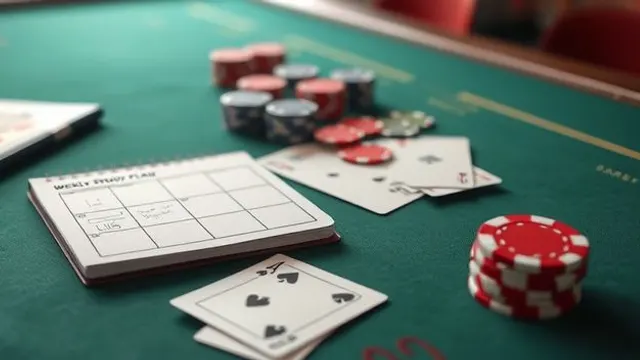
This article provides a systematic poker study plan, divided into weekly stages, covering progressive improvement from basic rules to advanced strategies, along with practical examples and common mistakes to help you improve efficiently.
How to Build a Poker Study Plan: Weekly Roadmap
Texas Hold'em is a complex game blending probability, psychology, and strategy. Many players progress slowly due to a lack of systematic study. By creating a weekly study plan, you can gradually strengthen your poker skills like training a muscle. This article provides a general roadmap covering definitions, principles, practical examples, common mistakes, and a summary.
Definition
A Texas Hold'em study plan is a purposeful, phased learning schedule, typically organized by week, focusing on specific skills or concepts. Its core is breaking down the vast body of knowledge into actionable small goals, such as hand ranges, position, pot odds, preflop strategy, postflop decisions, and more.
Principles
Learning poker is like learning a language: first master the alphabet (basic rules), then form words (starting hand selection), then build sentences (postflop actions), and finally write essays (overall strategy). By concentrating on one theme per week (e.g., positional advantage or bluffing frequency), your brain can internalize knowledge more deeply and develop conditioned reflexes. Additionally, combining review and adaptive training (e.g., using range tools) accelerates growth.
Weekly Roadmap (Example)
This roadmap assumes you already know the basic rules and can devote about one hour per day to study.
Week 1: Basic Rules and Starting Hands
- Goal: Memorize all hand strength rankings and master starting hand selection (e.g., recommended preflop ranges).
- Action: Use flashcards daily to practice hand rankings; read resources on preflop ranges.
- Practice: Play low-stakes cash games or freerolls, playing only specified starting hands (e.g., AA, KK, AK, etc.).
- Review: Record every hand and check whether you deviated from the range.
Week 2: Position Awareness and Pot Odds
- Goal: Understand the advantages of different positions (early, middle, late, blinds) and master pot odds calculations.
- Action: Study position probability charts; use practice software to calculate pot odds and implied odds.
- Practice: Play more hands in late positions (e.g., the button) and tighten your range in early positions.
- Review: Check for incorrect calls due to ignoring odds.
Week 3: Preflop Strategy and 3-bet/4-bet
- Goal: Learn to identify raises, value 3-bets, bluff 3-bets, and defending ranges.
- Action: Study standard preflop confrontation strategies; use range software to simulate common scenarios.
- Practice: Attempt a few 3-bets in position, paying attention to opponent reactions.
- Review: Record 3-bet sizes and opponent fold rates.
Week 4: Postflop Play—Continuation Bet (C-bet) and Check-Raise
- Goal: Master the frequency and sizing of flop continuation bets and the conditions for using check-raises.
- Action: Study C-bet strategies for different flop structures (dry, wet, paired boards); read articles on balancing check-raise ranges.
- Practice: Habitually C-bet on dry flops, tend to check on wet flops.
- Review: Analyze whether your check-raises were based on made hands or bluffs.
Week 5: Turn and River Decisions
- Goal: Understand value betting, blocker bets, and bluff ratios on the turn and river.
- Action: Learn the probability of improving on the turn; study value-to-bluff ratios on the river (roughly 2:1).
- Practice: Bet 2/3 pot on the turn when you have the nuts; decide on the river based on opponent ranges.
- Review: Check if your river bluff frequency is too high.
Week 6: Opponent Categorization and Adjustments
- Goal: Learn to adjust strategy based on opponent styles (tight-aggressive, loose-aggressive, passive, etc.).
- Action: Use a HUD or notes to tag opponent data; read resources on exploitative play.
- Practice: Bluff more against opponents who fold frequently; value bet against those who don't fold.
- Review: Record profit/loss changes after adjustments.
Week 7: Tournaments and ICM
- Goal: Understand tournament bubble phases, ICM pressure, and short-stack strategies.
- Action: Learn to use ICM calculators; study push/fold charts.
- Practice: Enter low buy-in tournaments and strictly follow push/fold ranges.
- Review: Analyze fold and all-in decisions near the final table.
Week 8: Comprehensive Review and Mental Game
- Goal: Integrate everything learned, develop a reviewing habit, and manage emotions (e.g., avoid tilt).
- Action: Review one concept card daily; practice meditation or rest techniques.
- Practice: Play multi-table sessions while maintaining focus.
- Review: Write a study journal, noting progress and areas for improvement.
Practical Example
Suppose you are in Week 3 and face a preflop raise. Effective stacks 100 BB. You are on the button with A♠Q♣. The button player opens to 3 BB, the small blind calls, and the big blind folds. You decide to 3-bet to 12 BB because AQo in position against a weak opponent is a value hand. The button folds, and the small blind calls. The flop comes K♦8♠2♥. The small blind checks. You continuation bet 8 BB, and the small blind folds. In this example, you executed a standard preflop 3-bet (though sometimes a call is fine) and a postflop C-bet (semi-bluff). During review, you should consider whether the 3-bet was optimal and what the small blind's range might have been.
Common Mistakes
- Trying to do too much: Attempting to learn every concept in one week leads to learning nothing. Focus on just one theme per week.
- Neglecting review: Playing without analyzing reinforces errors. Review at least 10 hands after each study session.
- Blindly following fixed ranges: Copying "perfect" starting hands without adjusting to opponents. Ranges are dynamic.
- Ignoring the mental aspect: Strong technique but emotional collapse leads to losing everything. Learn to manage emotions and bankroll.
Summary
Poker learning is a marathon, not a sprint. By building a weekly roadmap, you can systematically progress from basics to advanced levels, gradually establishing a decision tree. The key is consistent daily practice, regular review, and adjusting the plan based on your own progress. Remember, there is no absolutely correct strategy—only a process of continuous optimization.
Finally, ensure you use reliable resources (e.g., well-known poker training sites, books, or software) and avoid learning incorrect information from fragmented videos. Take it step by step, and your poker skills will improve significantly within a few months.
FAQ
- It is recommended to play no more than 500 hands per day, or 200-300 hands if you are also studying. The focus is on quality over quantity; after each hand, take a few seconds to think about the reason for your decision, then review and select key hands.