Why Mixed Games Are Attracting More New Casino Players
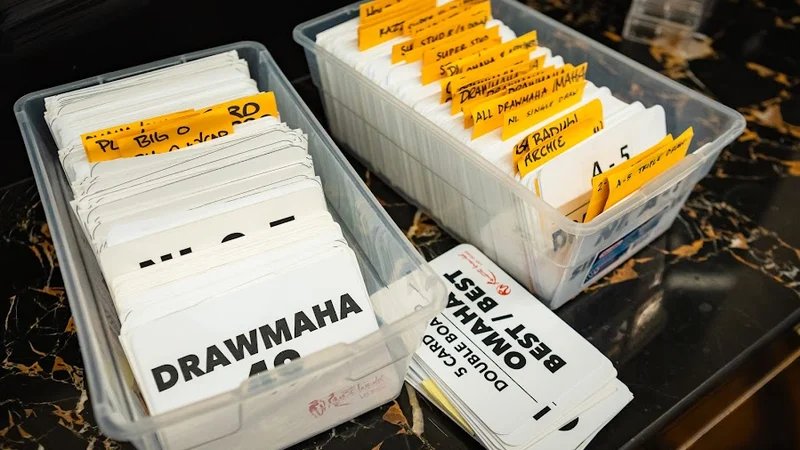
Mixed games like H.O.R.S.E. and Dealer's Choice are drawing record fields and new players. Here's why variety helps beginners and where to find these games.
Why Mixed Games Are Attracting More New Casino Players
At the World Series of Poker, 163 players each paid $10,000 to sit down at a table where nobody knew which game would be dealt next. That was the Dealer's Choice Championship, and it drew its biggest field ever. Bryce Yockey outlasted the field to win the event and his third bracelet.
An event drawing its biggest crowd ever at the world's most famous poker series is one where you don't get to specialise. That is the paradox at the heart of the mixed-game boom, and it explains why more new players are gravitating toward formats that rotate through several variants instead of drilling a single one.
Variety Is the Beginner's Best Friend
Walk into a single-game room and you are playing the one game everybody there has studied hardest. Hold'em has decades of training material, solver output and hand histories behind it. That is a steep hill for a newcomer. A rotation spreads that advantage thin.
In H.O.R.S.E. you move through Hold'em, Omaha Hi-Lo, Razz, Seven Card Stud and Stud Eight or Better, and relatively few players are strong in all five variants. Some players are excellent at two and passable at the rest. Dealer's Choice goes further, letting players nominate the variant each orbit, which is precisely why that championship field keeps growing.
The growth is not confined to the high buy-in version. Analysis of completed 2025 WSOP events found the $1,500 Dealer's Choice event rose from 530 entries in 2024 to 597 in 2025, a 12.6% increase.
There is a second reason these games suit you when you are starting out, and it gets mentioned far too rarely: in cash game formats, most of the different variants are played fixed limit. Bet sizes are capped. When you misread a situation, you lose a known amount rather than your whole stack. The Mixed Game Festival runs its cash games at $4/8 and $6/12 fixed limit, and across 15 editions it has awarded more than $200,000 in cash and prizes. Cheap mistakes make for fast learning.
What Your Brain Does When the Game Keeps Changing
Switching games mid-session sounds like a recipe for confusion. Learning research suggests the opposite, and this is where the case for mixed games gets interesting.
Psychologists call it interleaving: practising different problem types in mixed order rather than drilling one until it sticks. In a well-known study by Taylor and Rohrer, published in Applied Cognitive Psychology, children practising four kinds of maths problems in mixed order did worse during the practice session, then scored roughly double on a test the following day. The error analysis showed why: mixing taught them to work out which method each problem needed.
An eight-week study with undergraduate physics students, reported in a peer-reviewed paper, found median improvements of 50% and 125% on surprise tests containing unfamiliar problems when homework was interleaved rather than blocked. Robert and Elizabeth Bjork of UCLA's Learning and Forgetting Lab explain the mechanism as the contrasts and comparisons that switching forces on you, producing sharper processing and better transfer to new situations.
Now map that onto a rotation: Razz teaches you to read exposed cards, then Stud rewards the same skill with the goal turned upside down. Omaha Hi-Lo trains you to value half a pot, which sharpens how you value a whole one. Triple draw pushes you to think in terms of cards remaining rather than hands already made. Dealer's Choice asks you to name your strongest game under pressure, which is honest self-assessment dressed up as strategy. Fixed limits keep the price of each lesson predictable.
One afterthought, because it is the part people are not warned about. Those studies consistently found that interleaved practice feels worse while you are doing it. Your first mixed session will feel clumsy. That feeling is the learning taking hold.
Where Players Can Find These Games
Interest is running ahead of local supply in some markets. Organised club poker in New Zealand, for example, is Hold'em, and the nearest mixed events are closer than you would guess.
- Aussie Millions, Crown Melbourne, 24 April to 10 May 2026: 18 events, including an A$2,500 H.O.R.S.E. that drew 64 entries and an A$2,500 8-Game with 91 entries.
- Mixed Game Festival XIV, Bellagio, 31 May to 11 June 2026: low-stakes dealer's choice cash games, plus championship seats given away.
- The Festival Series, Europe: a 10-Game Mix High Roller in Bratislava with every Hold'em variant removed, plus a €550 T.O.R.S.E.S. Main Event at Rozvadov.
- Clubs New Zealand circuit: Texas Hold'em only, including the North Island championship at Hamilton.
Melbourne is a short flight and barely a timezone away from New Zealand, and the Aussie Millions returned there this year after a six-year absence. New Zealand players have held their own at this level before; Simon Watts won New Zealand's first WSOP bracelet in 2010, and David Yan became the second Kiwi bracelet winner in 2022.
Those two Australasian mixed events drew 64 and 91 players while the same series filled a 2,144-entry opener. But what happens to those numbers once everyone dealing Razz and Omaha in their lounge realises the same games are on a tournament schedule three hours away?
Between trips, online play fills the gap. Platforms built around breadth do well with players who want to sample several formats in a session, moving between poker, blackjack, roulette and baccarat at their own pace.
The Table Talks Back
Ask people why they stayed with mixed games and few of them lead with the maths. They talk about the table.
Jens Vörtmann, a WSOP bracelet winner and Player of the Series at The Festival Rozvadov, put the learning curve in perspective: "The basic rules are easy to learn within a few minutes, and if you already have experience in No-Limit Hold'em or PLO, your overall poker knowledge will allow you to play reasonably well very quickly." He described the draw as "the faster pace, the increased communication at the table, fewer headphones, and of course the variety of games".
That atmosphere lands well in markets where playing games together is ordinary. The NZ Plays 2025 report from IGEA and Bond University, published on 25 September 2025 from a survey of 820 households conducted in April 2025 with a 3.5% margin of error, found 91% of New Zealand homes include someone who plays games, 81% of New Zealanders play, the average player is 36, and 47% are women, with card, board and puzzle titles among the most popular categories.
There is older evidence pointing the same way. AUT's National Gambling Study, published in 2012, found 3.2% of adults had played poker for money or prizes with friends or family at a private residence, compared with 1.8% at a commercial venue. Dated now, but telling: the home game was roughly twice the size of the venue game.
The clever thing about the Mixed Game Festival is its etiquette rather than its game list. Explaining mixed game poker rules mid-hand is treated as normal, which is exactly how a lounge game brings someone new up to speed. Regulars make the same point in guides for Hold'em players moving into mixed games: low-limit tables are the noisiest, friendliest ones in the room, and asking how a game works is expected rather than frowned upon.
The Game That Grew Up in Your Lounge
Mixed games are a format catching up with how most of us learned cards in the first place: several games in one sitting, rules explained as you go, stakes kept sensible enough that curiosity does not cost much.
Record Dealer's Choice fields, dedicated mixed events back at Crown Melbourne and European organisers building 10-Game and T.O.R.S.E.S. tournaments all point the same direction, while the organised game in some markets stays single-variant. That gap is your opening.
Start with two variants. Learn them where a mistake costs a known amount. Let the rotation teach you the rest, and accept the awkward first session as the price of a skill that transfers.
Advisory Notice: Gambling should be treated as a form of entertainment, not a source of income. Set a budget you can afford to lose before you start playing, know your limits in advance, and walk away if you find yourself chasing losses or feeling pushed to keep going. If the enjoyment fades and worry sets in, confidential support is available at any time through the Gambling Helpline.
FAQ
- Mixed games are formats that rotate through several poker variants instead of playing just one. Common rotations include H.O.R.S.E. (Hold'em, Omaha Hi-Lo, Razz, Seven Card Stud, Stud Eight or Better) and Dealer's Choice, where players nominate the variant each orbit. Most cash game versions are played fixed limit, which caps bet sizes and limits how much you can lose on a single mistake.