Phil Ivey Edge Sorting Case Explained: Baccarat, Crockfords, Borgata and Poker's Biggest Legal Debate
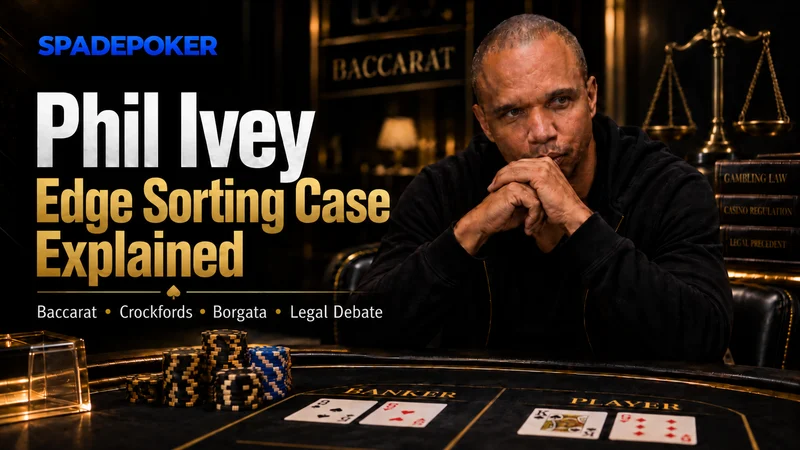
Phil Ivey's edge-sorting cases with Crockfords and Borgata became one of gambling's biggest legal debates. Learn what happened, what edge sorting means and how it affected his legacy.
Phil Ivey's edge-sorting case is one of the most famous legal controversies in modern gambling. It is also one of the most misunderstood stories connected to a poker player. The case did not come from a poker tournament. It did not involve marked cards at a poker table. It did not involve collusion in a cash game. It came from Punto Banco baccarat sessions involving Phil Ivey, advantage player Cheung Yin Sun and two major casinos: Crockfords in London and Borgata in Atlantic City.
The central question was simple to ask, but difficult to answer. Was edge sorting a legal advantage-play technique, a casino mistake exploited by skilled gamblers, or cheating? In court, Ivey lost the most important legal battles. In poker culture, the debate never fully disappeared. That is why the Phil Ivey edge-sorting case remains so important. It sits at the intersection of skill, gambling law, casino procedure, ethics, reputation and the long-running question of where advantage play ends and cheating begins.
What Was the Phil Ivey Edge-Sorting Case?
The Phil Ivey edge-sorting case involved baccarat sessions in which Ivey and Cheung Yin Sun used tiny asymmetries on the backs of playing cards to gain an advantage. The most famous dispute came from Crockfords Club in London. In August 2012, Ivey played Punto Banco at Crockfords and won approximately £7.7 million. The casino refused to pay the winnings, arguing that edge sorting amounted to cheating. Ivey sued to recover the money, but the UK Supreme Court ultimately ruled against him.
A separate dispute involved Borgata in Atlantic City. Borgata sued Ivey and Cheung Yin Sun over baccarat sessions, arguing that they used edge sorting with specific card-handling and table-condition requests to gain an unlawful advantage. Public court records describe the accommodations requested to make the method work.
For poker fans, the key detail is this: the edge-sorting controversy was a baccarat case, not a poker cheating case. Still, because Ivey is one of poker's biggest names, the story became permanently attached to his public legacy.
What Is Edge Sorting?
Edge sorting is an advantage-play technique based on small differences in the pattern printed on the back of certain playing cards. If the card-back design is not perfectly symmetrical, and if important cards are rotated in a consistent way, a skilled player may be able to identify whether a face-down card belongs to a useful group before it is revealed. In Punto Banco baccarat, that information can be valuable because some card values are much more important than others.
The UK Supreme Court described edge sorting as a highly specialist technique that improved Ivey's chances of winning. The court materials explain that the technique depended on identifying small differences in the pattern on the reverse of the cards and exploiting that information.
Edge sorting does not require physically marking cards with ink, scratches or hidden devices. That is one reason the case became so controversial. Supporters viewed it as observation and advantage play. Casinos and courts focused on the way the cards were arranged and the way Ivey and Sun obtained the conditions needed for the technique to work.
Phil Ivey and Cheung Yin Sun
Phil Ivey did not act alone in the edge-sorting cases. Cheung Yin Sun, also known as Kelly Sun, was central to the technique. She was widely described in coverage of the cases as an expert advantage player with deep knowledge of edge sorting. Her role mattered because the method required careful observation, communication and specific handling of the cards.
Ivey's fame brought the case global attention, but Sun's edge-sorting expertise was a major part of the story. That distinction is important. The case was not simply "Phil Ivey saw something at a baccarat table." It was a coordinated advantage-play approach that depended on knowing which card values mattered, asking for the right game conditions and using the card-back asymmetry once the pattern had been created.
Phil Ivey and Crockfords: The £7.7 Million Dispute
The Crockfords dispute is the most famous part of the Phil Ivey edge-sorting story. In August 2012, Ivey played Punto Banco at Crockfords Club in London and won approximately £7.7 million. The casino did not pay the winnings. Instead, it returned his original stake and refused to release the profit.
Ivey sued Genting Casinos, the owner of Crockfords, arguing that he had used legitimate skill and observation. He did not deny using edge sorting. The dispute was about whether that method counted as cheating under the law. The case moved through the English courts and eventually reached the UK Supreme Court.
In 2017, the Supreme Court unanimously dismissed Ivey's appeal. The press summary states that the High Court had held Ivey's use of edge sorting to be cheating, and the Supreme Court upheld the outcome against him. That ruling was decisive for the Crockfords money. Ivey did not receive the £7.7 million in disputed winnings.
Phil Ivey and Borgata: The Atlantic City Case
The Borgata case created a second major legal front. Borgata Hotel Casino & Spa in Atlantic City sued Phil Ivey and Cheung Yin Sun over baccarat sessions connected to edge sorting. The casino claimed that Ivey and Sun won millions by using the technique together with specific requests about cards and game procedure. Public federal court records describe several accommodations that Ivey and Sun requested, including a private area or pit and other conditions that helped make the edge-sorting method possible.
The Borgata dispute did not have the same simple public shape as Crockfords, where the central story was unpaid winnings. Borgata sought to recover money it said had been won through improper play. The case lasted for years and was eventually settled. Public reporting in 2020 stated that Ivey and Borgata had reached a settlement in the six-year edge-sorting lawsuit. The exact private financial impact of the Borgata case is not fully knowable from public information. What is clear is that the Atlantic City dispute helped keep the edge-sorting controversy attached to Ivey's name long after the Crockfords decision.
Was Phil Ivey Accused of Cheating?
Yes, casinos argued that Phil Ivey's edge sorting amounted to cheating. The most important legal point is that the UK Supreme Court ruled against Ivey in the Crockfords case. The court's press summary states that the High Court held his use of edge sorting was cheating, and the Supreme Court dismissed his appeal.
However, the wording should be handled carefully. This was not a poker cheating scandal. It was a baccarat legal dispute about the meaning of cheating in gambling, the role of dishonesty and whether Ivey's method crossed the line. The case divided gambling fans because it raised difficult questions about skill, deception and casino responsibility.
Ivey's side argued that he used skill and that casinos were responsible for protecting their own games. Casino-side arguments focused on the fact that the method required manipulating game conditions and getting the dealer to turn cards in a way that created the advantage. That is why the public debate remained divided even after the legal rulings. In law, Ivey lost. In poker and gambling culture, some people still viewed the case as advantage play rather than traditional cheating.
Was This a Poker Scandal?
No. The Phil Ivey edge-sorting case was not a poker scandal in the direct sense. It involved Punto Banco baccarat, not Texas Hold'em, Omaha, mixed games or any poker tournament format. There were no allegations that Ivey cheated in a poker event as part of this case. The dispute involved casino baccarat, card backs, game procedure and whether the method used to gain an edge was legal.
That distinction matters for Ivey's poker legacy. The controversy affected his public reputation because he is a poker superstar. But it should not be described as evidence that he cheated at poker. A responsible article should separate those things clearly.
Why Poker Players Debated the Case
Poker players debated the case because advantage play is part of gambling culture. Casinos build games with mathematical edges. Skilled gamblers look for mistakes, weaknesses, promotions, rule gaps or procedural errors that can shift the advantage. Card counters, hole-card players and other advantage players have long argued that using available information is part of the game.
That is why some poker fans sympathized with Ivey. From that perspective, he did not secretly mark the cards. He did not use a hidden device. He noticed a weakness in the casino's setup, asked for conditions that helped him use it and played accordingly.
The opposing view is that Ivey and Sun did more than observe. They persuaded casino staff to arrange the game in a way that made the edge possible, while the staff did not understand the true purpose of the requests. That is the part courts and casinos treated as crossing the line. The debate survives because both sides touch something real. Gambling rewards edges. But casinos and courts may reject edges created through deception or manipulation of game procedure.
How the Edge-Sorting Case Affected Phil Ivey's Reputation
The edge-sorting case made Phil Ivey's public legacy more complicated. Before the controversy, Ivey was mostly discussed as a quiet poker genius, high-stakes killer and one of the greatest all-around players in the game. After the cases, his name also became connected to one of gambling's most famous legal disputes.
For some fans, the case damaged his image. They saw the court rulings and casino arguments as proof that the method crossed an ethical line. For others, the case reinforced Ivey's reputation as a fearless advantage seeker who found an edge in a casino game and used it. Both reactions explain why the controversy still follows him.
It did not erase his poker achievements. Ivey remains an 11-time WSOP bracelet winner and one of the most respected players in poker history. But it added a legal and ethical chapter that every complete Phil Ivey profile has to address.
Did Phil Ivey Get Paid by Crockfords?
No. Phil Ivey did not receive the £7.7 million in disputed Crockfords winnings. Crockfords refused to pay the winnings after the 2012 baccarat sessions. Ivey sued to recover the money, but the UK Supreme Court dismissed his appeal in 2017. The casino returned his original stake, but the disputed profit was not paid to him. That outcome is one of the reasons the Crockfords case became so famous. It was not only an argument about gambling ethics. It was also a dispute over a very large unpaid casino win.
FAQ
- Edge sorting is an advantage-play technique that exploits tiny asymmetries in the pattern on the back of playing cards. By getting cards rotated in a consistent way, a player can identify whether a face-down card belongs to a useful group before it is revealed. It does not involve physically marking cards.