Tom Dwan Poker Style
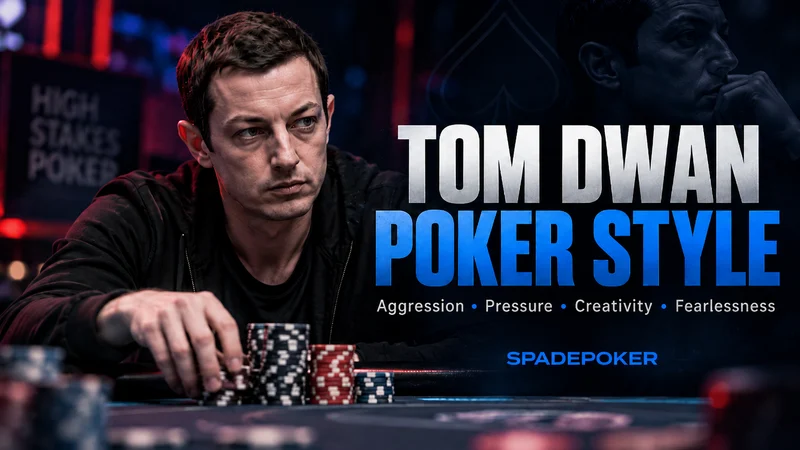
How Tom Dwan plays poker: wide ranges, multi-street pressure, deep-stack creativity, selective aggression and why opponents still find him hard to read.
Tom Dwan's poker style is one of the main reasons he became a legend. He did not become famous by waiting for premium hands. He became famous by forcing opponents to play more poker than they wanted to play.
Under the screen name "durrrr," Dwan built his reputation in the biggest online cash games of the 2000s. He played wide ranges, attacked weakness, applied pressure across multiple streets and made decisions that often looked strange compared with more conventional high-stakes strategy. That unpredictability became his identity.
But calling Tom Dwan simply "aggressive" misses the point. His best poker was not random aggression. It was controlled pressure supported by range awareness, deep-stack understanding, opponent reads and a willingness to take lines other players were uncomfortable using.
What Is Tom Dwan's Poker Style?
Tom Dwan's poker style can be described as aggressive, creative, adaptive and pressure-based. He is willing to play more hands than many traditional players, especially in deep-stacked cash games where postflop skill matters more.
That creates uncertainty. If Dwan raises preflop, opponents cannot immediately place him on a narrow premium range. If he continues betting across multiple streets, they cannot automatically assume he has a strong hand. That uncertainty is the foundation of his style. His opponents are constantly forced to ask the same question: Is he strong, or is this another bluff?
Why Tom Dwan Was So Aggressive
Dwan grew up in online poker environments where aggression was essential. High-stakes six-max and heads-up games reward players who fight for pots rather than wait for cards. Dwan embraced that style early. During his rise he was widely described as a hyperaggressive player who became known throughout the high-stakes online community after beating increasingly large No-Limit Hold'em games. Elite players interviewed at the time repeatedly emphasized how active and difficult he was to play against.
That aggression had an important strategic benefit. When a player raises and bets frequently, opponents cannot simply fold everything except strong hands. Eventually, they have to defend wider. That is when the real pressure begins. Dwan forced opponents into larger pots with weaker holdings than they normally wanted to play.
Dwan's Wide Preflop Ranges
One of the clearest characteristics of Dwan's game is his willingness to enter pots with wide ranges. That does not mean playing every hand. It means understanding that in deep-stacked cash games, position, opponent tendencies and implied odds can make unusual starting hands profitable.
Modern analysis of Dwan's televised play still highlights how wide his preflop selections can become. Strategy reviews of his cash-game appearances have noted very loose holdings that created difficult postflop situations, including hands such as 9-4 suited, J-8 offsuit, J-10 offsuit and 5-4 offsuit. The point is not that those hands are automatically mistakes, but that Dwan has the experience and postflop ability to navigate ranges that average players should not simply copy.
This is important. Dwan's style is dangerous to imitate without understanding why he chooses those hands.
Pressure Across Multiple Streets
Dwan's aggression does not stop preflop. His real strength has often been his willingness to continue applying pressure after the flop. Many players can raise light before the flop. Far fewer are comfortable firing turn and river bets when the pot becomes enormous. Dwan built his reputation by doing exactly that.
He understood that opponents often defend the flop wider than they are willing to defend later streets. That creates opportunities to use large turn and river bets to attack capped or uncertain ranges. When Dwan senses weakness, he often keeps pushing. That is why playing against him can feel exhausting.
Deep-Stack Poker Is Where Dwan Becomes Most Dangerous
Dwan's style is especially effective when stacks are deep. Deep stacks create more decisions. More decisions create more opportunities for skill. Instead of simply deciding whether to commit 100 big blinds, players may need to navigate 200, 300 or even more big blinds across several streets. That gives creative players more room to maneuver.
Historical breakdowns of Dwan's largest online pots have highlighted exactly this point. With roughly 300 big blinds effective, decisions that would be marginal at normal stack depth became more attractive because implied odds changed dramatically. This is one reason Dwan became such a natural fit for high-stakes cash games. Deep stacks gave him space to create problems.
Tom Dwan and Unconventional Lines
Dwan became famous for lines that did not always look standard. He might lead into a preflop raiser. He might check a hand other players would automatically bet. He might use a large river sizing in a spot where opponents expected something smaller. That unpredictability made him difficult to model.
Phil Galfond once described Dwan as a player who had effectively created his own style rather than fitting neatly into standard categories. That observation remains useful because Dwan's game has always been built around finding lines that attack what a specific opponent expects.
Why Dwan's Bluffs Became Famous
Tom Dwan is strongly associated with huge bluffs. But the important part is not simply that he bluffed often. It is that he was willing to bluff in pots where the financial pressure was enormous. That changes everything.
A $1,000 bluff and a $500,000 bluff may use the same technical logic, but psychologically they are completely different experiences. Dwan became comfortable making those decisions at stakes where most players would become more conservative. That fearlessness gave him a strategic advantage. Opponents knew he was capable of bluffing in spots where many players would never risk the money.
The Power of Dwan's Table Image
Dwan's aggressive reputation became an asset in itself. If opponents believe you are constantly bluffing, your value bets become more profitable. If they believe you can show up with almost anything, they are forced to call more often. Dwan understood this dynamic extremely well.
Barry Greenstein described him as a player who forces opponents to play pots and called him a "table captain." David Benefield said that when Dwan was playing and running well, he could be the scariest player at the table. That reputation created action. And action created opportunities.
Dwan Is Not Aggressive All the Time
This is one of the biggest misunderstandings about Tom Dwan. The best version of his game is not permanently aggressive. It is selective. Nick Schulman's description of Dwan is especially useful here: Dwan could be aggressive when the situation required aggression and passive when the situation required patience. That is much harder than simply betting frequently.
Good aggressive poker requires knowing when not to attack. Dwan's ability to slow down in the right spots helps protect the aggressive parts of his range.
Adaptation Is at the Center of Dwan's Strategy
Dwan has repeatedly emphasized adaptation. In an early interview, he explained that at the highest stakes, the skill differences between elite players could be relatively small, making adaptation to opponents especially important. That idea helps explain why his style is difficult to summarize with one chart.
Dwan is not trying to play exactly the same way against every opponent. He changes. Against someone who folds too much, he can bluff more. Against someone who calls too much, he can value bet wider. Against a player who attacks aggressively, he can trap. That flexibility is a major part of his longevity.
Tom Dwan vs Modern GTO Poker
Dwan became famous before solver-driven poker became mainstream. That does not mean his style is anti-GTO. Many concepts associated with modern poker were already visible in his game: wide ranges, balanced aggression, pressure across multiple streets, unusual sizings and an understanding of how ranges interact rather than focusing only on individual hands.
The major difference is that Dwan learned many of these ideas through enormous amounts of high-stakes experience rather than modern solver study. That gives his style an old-school/new-school hybrid quality. He came from online poker mathematics, but he also developed decades of live reads, private-game experience and opponent-specific adjustments.
Cash Games vs Tournament Poker
Dwan's style is naturally better suited to cash games than traditional tournament structures. Cash games allow deeper stacks, unlimited rebuys and repeated interaction with the same opponents. Those conditions reward adaptation. Dwan himself said early in his career that cash games were his preferred environment and that he favored short-handed No-Limit Hold'em and Pot-Limit Omaha because he believed his edge could be larger there.
Tournaments reduce some of that freedom. Stacks become shorter, blind levels increase and survival has strategic value. Dwan can still perform in tournaments, but cash games give his creativity more room.
Tom Dwan and Pot-Limit Omaha
Dwan's skill was never limited to No-Limit Hold'em. Pot-Limit Omaha was a major part of his online high-stakes career. PLO naturally creates larger pots, closer equities and more complicated postflop decisions. Those characteristics fit Dwan well. The game rewards players who are comfortable with variance and who can make difficult decisions when many hands have significant equity.
Dwan's willingness to play both NLHE and PLO at nosebleed stakes helped establish his reputation as an all-around cash game player rather than a one-format specialist.
Position Matters Enormously in Dwan's Game
Position is one of the foundations of aggressive poker. When acting last, Dwan can observe what opponents do before making his own decision. That information allows him to play wider ranges and apply more pressure. It also helps explain why simply copying his starting hands is dangerous. A hand that Dwan can profitably play in position against a specific opponent may be a losing hand for an average player in a different situation. The hand itself is only part of the decision.
Why Dwan Makes Opponents Uncomfortable
The hardest thing about playing Tom Dwan is uncertainty. He can have strong hands. He can have weak hands. He can take unusual lines with both. That makes pattern recognition difficult. Most players become easier to play against when their tendencies become predictable. Dwan's best poker does the opposite. His aggression forces opponents to make more marginal decisions, and his ability to change gears prevents them from finding a simple counter-strategy.
Fearlessness in Million-Dollar Pots
Dwan's style becomes most visible when the stakes become extreme. His long reputation for bold high-stakes play was highlighted when he was announced as an ACR Pro in 2024, pointing to major televised and streamed pots across his career. This matters strategically. Many players become tighter when the absolute amount of money increases. Dwan has repeatedly shown a willingness to continue making aggressive decisions even when the pot becomes life-changing for most people. That does not mean he never feels pressure. It means he has trained himself to keep making the play he believes is correct.
FAQ
- Tom Dwan's style is best described as aggressive, creative, adaptive and pressure-based. He plays wide ranges, applies pressure across multiple streets and is comfortable taking unconventional lines, especially in deep-stacked cash games.