check-call
Editor: dezhoupuke.orgRelated Glossary
Capped Range
Capped Range
In practice, identifying an opponent's capped range can help you make aggressive bets or bluffs, as the opponent will h…
Uncapped Range
Uncapped Range
Term: Uncapped Range An uncapped range means that the range of hands a player may hold has no upper limit, i.e., it inc…
Marginal Showdown Value
Marginal Showdown Value
In practice, when holding such a hand, one should avoid aggressive betting or calling large bets, as the opponent may h…
Second Pair
Second Pair
In practice, it is commonly used to assess hand strength after the flop, typically weaker than top pair but stronger th…
Check-Call
Check-Call
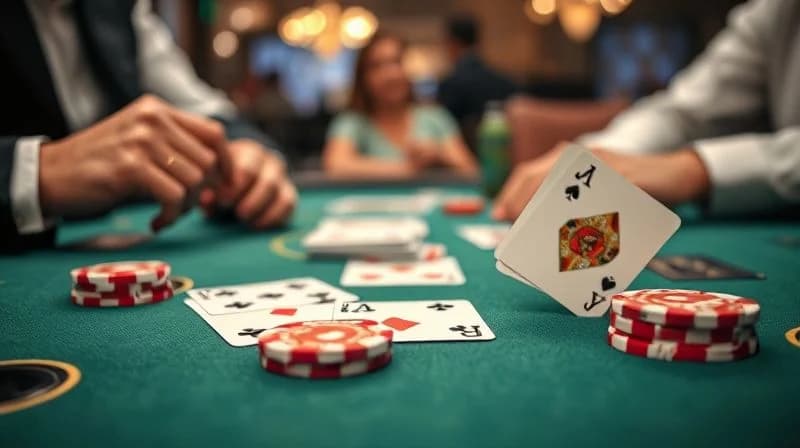
The core meaning of this action is: without actively betting, the player passively accepts the opponent's wager to stay…
Delayed Turn Bet
Delayed Turn Bet
A delayed turn bet is a poker strategy where a player checks or calls on the flop with the plan to bet on the turn, typ…
Pot Limit Omaha Hi-Lo Strategy
Pot Limit Omaha Hi-Lo Strategy
Pot Limit Omaha Hi-Lo Strategy refers to the strategic approach to playing Pot Limit Omaha with a split pot between hig…
River Bet-Call
River Bet-Call
A poker action on the river where a player bets and then calls an opponent's raise, typically indicating a hand strong …
River Bet-Fold
River Bet-Fold
A poker play where a player bets on the river and then folds to a raise from an opponent.
River Check-Fold
River Check-Fold
In poker, a river check-fold is when a player checks on the river with the intention of folding if their opponent makes…
River Check-Call
River Check-Call
A poker action where the player checks on the river and then calls an opponent's bet.
Preflop Check-Call
Preflop Check-Call
A preflop check-call is a poker action where a player, after checking declining to bet in the preflop betting round, su…
Related Strategy
Top Pair Weak Kicker: How to Extract Value from Marginal Hands and Avoid Traps
Top pair weak kicker is one of the most common and error-prone hand types in Texas Hold'em. This article systematically explains how to make optimal decisions in different positions, post-flop stages, and against different opponents to avoid being outdrawn or falling into value traps while maximizing profit.
Straight and Flush Draw Boards: How to Handle Scare Cards on the Turn or River
When straight or flush draws complete, you may face challenges from opponents bluffing or value betting. This article explains how to identify scare cards, adjust your range, and adapt strategies based on position and opponent type, helping you make optimal decisions on dangerous boards.
Thin Value River Extraction: How to Extract Maximum Profit from Marginal Hands
Thin value river extraction is an advanced poker technique that refers to value betting on the river with a hand that is weak but still ahead of the opponent's range. This article will teach you how to identify and execute thin value river bets from three dimensions: hand range analysis, opponent type assessment, and bet sizing, helping you avoid over-bluffing or missing value by checking.
Straight and Flush Scare Card Strategy: How to Handle Scare Cards
This article explains the concept of Scare Cards in poker, focusing on how scare cards on straight and flush boards affect decision-making, and provides practical strategies to help you avoid mistakes on dangerous board textures.
Big Blind Defense Wide Range Techniques: A Complete Guide from Theory to Practice
The big blind is the most challenging yet potentially profitable position in Texas Hold'em. This article systematically explains the core logic of defending a wide range from the big blind, including preflop range construction, pot odds calculation, postflop adjustments, and common mistakes. Whether you are a beginner or an intermediate player, these techniques will help you defend your blind more accurately and improve your overall win rate.
Deep Stack Cash Game Postflop Three-Street Plan: Systematic Play from Flop to River
This article provides a systematic three-street plan for deep stack 100BB+ cash game players from flop to river. It covers range construction, bet sizing selection, and the core logic of turn and river board evolution, helping you make better decisions in deep stack situations and avoid common mistakes.
Big Blind Defense vs Button Min-Open: Range Construction and Postflop Execution
This article systematically explains the defense strategy for the big blind facing a button min-raise, including principles for constructing preflop calling and 3-bet ranges, postflop adjustments on different board textures, and exploitative adjustments against various opponent types. Suitable for players looking to improve their blind battle skills.
Trap and Setmine Strategy Against Maniac Opponents
Against aggressive maniac opponents, trap and setmine strategies are effective counters. This article details how to use small pairs or medium-strength hands to set traps, lure opponents into continued bluffing, maximize value after hitting a hand, while avoiding over-commitment.
How to Effectively Execute Flat Call Strategy OOP vs 3bet
In Texas Hold'em, when out of position OOP facing a 3bet, many players tend to either fold or 4bet. But choosing to Flat Call at the right time can balance ranges, control the pot, and leverage postflop skills. This article explains in detail the applicable scenarios, range construction, postflop strategies, and common mistakes of OOP Flat Call versus 3bet, helping you improve profitability in deep stack confrontations.
How to Extract Maximum Value with Pocket Aces: Jonathan Little Hand Analysis
This article analyzes a classic hand from a high-stakes cash game where Jennifer Tilly slow-plays AA, explaining how to protect a check-calling range to maximize value, and discusses the correct decision when facing an all-in on the turn.
River Thin Value Betting Tips: Extract Maximum Profit with Precision
This article explains the core principles and practical tips for thin value betting on the river, including hand selection, range construction, bet sizing, and opponent tendency analysis. It helps you profit consistently in marginal situations, avoiding over-bluffing or missing value.
Pro Tip with Apestyles: Lock in Your Preflop and Postflop Checklists
This tutorial explains how to build preflop and postflop checklists to help players systematize decision-making. Covers core strategies such as starting hand selection, positional advantage, postflop value betting and bluffing, suitable for intermediate to advanced players to improve consistency and profitability.
Related Players
' width='512' height='512'/%3E%3Ctext x='256' y='256' text-anchor='middle' dominant-baseline='central' font-family='system-ui,sans-serif' font-size='240' font-weight='bold' fill='hsl(278,30%25,85%25)'%3ECY%3C/text%3E%3C/svg%3E)
Chongxian Yang
 China
China
Chongxian Yang is a Chinese professional poker player with over $2.49 million in live tournament earnings, highlighted by a third-place finish in the 2025 WSOP $25,000 Mixed PLO/NLH High Roller for $598,285. He has cashed 24 times at the World Series of Poker between 2024 and 2026, including four final tables, and is known for a solid, aggressive style that excels in high-stakes events.
' width='512' height='512'/%3E%3Ctext x='256' y='256' text-anchor='middle' dominant-baseline='central' font-family='system-ui,sans-serif' font-size='240' font-weight='bold' fill='hsl(321,30%25,85%25)'%3EVL%3C/text%3E%3C/svg%3E)
Vincent Lam
 Canada
Vincent Lam is a Canadian professional poker player from Edmonton, Alberta, with over $557,000 in live tournament earnings and more than $678,000 including online results. He has multiple WSOP final tables and a deep run in the 2021 WSOP Main Event, known for his sharp reads and fearless aggression.
' width='512' height='512'/%3E%3Ctext x='256' y='256' text-anchor='middle' dominant-baseline='central' font-family='system-ui,sans-serif' font-size='240' font-weight='bold' fill='hsl(259,30%25,85%25)'%3EAO%3C/text%3E%3C/svg%3E)
Anil Olgun Ozdemir
 Türkiye
Anil Olgun Ozdemir is a professional poker player from Turkey, currently a PokerStars sponsored player, with over 10 years of online and live tournament experience. His career total winnings exceed $325,000, and his best result is runner-up in the 2017 PokerStars Festival Bucharest Main Event.
' width='512' height='512'/%3E%3Ctext x='256' y='256' text-anchor='middle' dominant-baseline='central' font-family='system-ui,sans-serif' font-size='240' font-weight='bold' fill='hsl(249,30%25,85%25)'%3ECB%3C/text%3E%3C/svg%3E)
Christopher Bello
 United States
Christopher Bello, American poker player, world rank 19432, career earnings over $170,000. Known for a solid style, achieved good results in regional tournaments multiple times.
' width='512' height='512'/%3E%3Ctext x='256' y='256' text-anchor='middle' dominant-baseline='central' font-family='system-ui,sans-serif' font-size='240' font-weight='bold' fill='hsl(311,30%25,85%25)'%3EKE%3C/text%3E%3C/svg%3E)
Kenneth Eng
United States
Kenneth Eng, American poker player, world ranking approximately 28643, career earnings over $110,000.
' width='512' height='512'/%3E%3Ctext x='256' y='256' text-anchor='middle' dominant-baseline='central' font-family='system-ui,sans-serif' font-size='240' font-weight='bold' fill='hsl(265,30%25,85%25)'%3EMW%3C/text%3E%3C/svg%3E)
Michael Wadlow
United States
American poker player, world ranking 28198, total earnings approximately $111,660. Active in both online and live tournaments, known for a solid style, has achieved good results in small to medium-sized events multiple times.
' width='512' height='512'/%3E%3Ctext x='256' y='256' text-anchor='middle' dominant-baseline='central' font-family='system-ui,sans-serif' font-size='240' font-weight='bold' fill='hsl(5,30%25,85%25)'%3EJN%3C/text%3E%3C/svg%3E)
Johnathan Nader
United States
Related News

Which poker habit took you too long to unlearn? Reddit players discuss
On Reddit r/onlinepoker, players share their hardest poker habits to break. This article summarizes the most common ones, including overplaying flush draws, overvaluing small pairs, and being too passive post-flop, along with practical advice to fix these habits.
JQ suited flop check, river jam caught by full house, was this hand a mistake?
A player in a 1/3 no-limit hold'em cash game, holding JQ suited, raised on the button. Flopped a flush draw and checked. Turned top pair, rivered trips. Facing a large bet, the player jammed, only to be snap-called by opponent's 77 full house. This article reviews the key decision errors in the hand.

How to Play Medium Pairs on a Connected Paired Flop? Cláudio Davino's In-Depth Analysis
In this lesson, Cláudio Davino analyzes a situation where many players make mistakes: how to play medium pairs on a connected paired flop. He explains why the best strategy is often not to continuation bet and provides alternatives.

Complete Analysis of Three Broadway Board e.g., AKQ Play
In-depth analysis of post-flop strategy when three broadway cards e.g., AKQ appear on the board, covering range analysis, bet sizing, common mistakes, and practical examples, helping players find balance between strong hands and potential bluffs.

Complete Analysis of Monotone Board Defense and Attack Strategies
This article provides in-depth explanations of its definition, probability principles, attack and defense strategies, common mistakes, and practical examples, helping players make correct decisions on the flop, turn, and river.

The Value of Postflop Position: The Choice Between Betting vs Check-Raise
This article provides an in-depth analysis of leveraging postflop positional advantage, comparing the two strategies of active betting versus check-raising, including their applicable scenarios, principles, and common misconceptions, to help players make optimal decisions based on position, board structure, and opponent ranges.

Call and Bet Frequency on Two-tone Boards
Two-tone board is a flop with two cards of the same suit, which significantly impacts player strategy. This article explains its definition, principles, practical strategies, and common misconceptions to help players optimize their call and bet frequencies.

Texas Hold'em Four Streets Streets Analysis: Flop, Turn, River Detailed Explanation
This article systematically analyzes the concepts, principles and strategies of the four streets in Texas Hold'em: preflop, flop, turn, river, helping players improve hand reading and decision-making through practical examples and common misconceptions.

Cash Game Buy-in Depth Comparison: Pros and Cons of 100BB vs 200BB vs Short Stack
This article provides an in-depth analysis of the pros and cons of different buy-in depths in cash games short stack, 100BB, 200BB+, covering strategy adjustments, risk-reward characteristics, and practical examples to help players make optimal choices based on their own style and session.

Texas Hold'em Defense Against Steal Strategy: How to Effectively Defend Blinds
Defense against steal is a key strategy in Texas Hold'em to resist opponents' blind stealing, involving range selection, position considerations, stack depth adjustments, etc. This article explains the principles of defense against steal, practical examples, and common mistakes, helping players reduce blind losses and implement countermeasures.

Mid-Stage Mystery Bounty Tournament Strategy Explained
In-depth exploration of strategy adjustments in the mid-stage of mystery bounty tournaments, including key points such as bounty value assessment, ICM pressure, and balancing aggression and defense.
Related
Check-Call
The core meaning of this action is: without actively betting, the player passively accepts the opponent's wager to stay…
GlossaryWhat is a Call in Poker?
A call matches the current bet or raise and keeps you in the hand. It is not a raise, not a check, and not a HUD Call% …
GlossaryCheck
Its main purpose is to pass the action to the next player when the player has no desire to bet, while avoiding the risk…