Double Up
Editor: dezhoupuke.orgRelated Glossary
Pay Jump Equity
Pay Jump Equity
In practice, this concept helps players evaluate whether it is worth taking risks to advance or defend, because elimina…
Double Up
Double Up
This is a common way to increase chip stacks in Texas Hold'em tournaments and cash games, especially in the late stages…
Triple Up
Triple Up
In practice, this term is often used to describe a short-stacked player rapidly accumulating chips through a high-risk …
Min-Cash Zone
Min-Cash Zone
The Min-Cash Zone is the stage in a poker tournament near the money bubble where players adjust their strategy to survi…
Starting Chips
Starting Chips
Starting chips are the initial stack of chips each player receives at the beginning of a poker tournament or cash game,…
Run It Multiple Times
Run It Multiple Times
A poker practice where, in an all-in situation, players agree to deal the remaining board cards multiple times, with ea…
ICM Calculator
ICM Calculator
A tool that applies the Independent Chip Model ICM to convert tournament chip stacks into monetary equity, helping play…
Short Stack Jam
Short Stack Jam
A short stack jam is an all-in bet made by a player with a small chip stack, typically used in tournaments when the sta…
Chip Down
Chip Down
In poker, chip down refers to the process or state of a player's chip stack decreasing, typically due to losing pots or…
Unlimited Rebuy
Unlimited Rebuy
A poker tournament format allowing players to purchase additional chips any number of times during a specified rebuy pe…
Shootout
Shootout
A tournament format where each table plays down to one winner, who advances to the next round until a final table deter…
Related Strategy
How to play during the bubble?
How to Play the Bubble: Win Rate, Common Mistakes, Scenarios & FAQ — An in-depth analysis of tournament bubble periods and the ICM model, teaching you how to make optimal decisions before the money threshold. Covers stack management, squeeze plays, and opponent range adjustments to help you safely navigate the bubble and charge toward the prize pool.
15BB Resteal Strategy: How to Effectively Counter Opponent's Steals
In tournaments, when the effective stack is around 15BB, restealing is a key profit-making move. This article details the timing, range, bet sizing, and considerations for restealing, helping you counter opponents' aggressive steals when short-stacked to double up or accumulate chips.
ICM vs cEV Switching Point: When to Shift from Chip Value to Survival Value
In Texas Hold'em tournaments, early on you should pursue maximizing cEV, but as the money bubble approaches or the final table nears, ICM pressure increases and strategy needs to shift to survival. This article explains the quantitative judgment method of the switching point, practical scenarios, and typical mistakes.
Blind Stealing Strategy in Tournament Bubble: How to Exploit ICM Pressure to Increase Chips
This article deeply analyzes the strategic logic of blind stealing during the tournament bubble, combining ICM pressure and opponent ranges to provide a specific execution framework, key decision points, and common mistakes, helping players safely accumulate chips during the bubble.
Related Players
' width='512' height='512'/%3E%3Ctext x='256' y='256' text-anchor='middle' dominant-baseline='central' font-family='system-ui,sans-serif' font-size='240' font-weight='bold' fill='hsl(104,30%25,85%25)'%3EDS%3C/text%3E%3C/svg%3E)
Dan Smith
 United States
Dan Smith is an American professional poker player from Manalapan, New Jersey, now residing in Las Vegas. He is best known for his high-stakes tournament success, with over $59 million in live earnings, a WSOP bracelet, and the 2012 GPI Player of the Year award.
' width='512' height='512'/%3E%3Ctext x='256' y='256' text-anchor='middle' dominant-baseline='central' font-family='system-ui,sans-serif' font-size='240' font-weight='bold' fill='hsl(58,30%25,85%25)'%3EFF%3C/text%3E%3C/svg%3E)
Federico Francisco Quevedo Diaz
 Costa Rica
Costa Rican poker player, world ranking 5507, total earnings $589,151. Known for a solid style, multiple cashes in Latin American events.
' width='512' height='512'/%3E%3Ctext x='256' y='256' text-anchor='middle' dominant-baseline='central' font-family='system-ui,sans-serif' font-size='240' font-weight='bold' fill='hsl(336,30%25,85%25)'%3ERF%3C/text%3E%3C/svg%3E)
Roar Flotre
 Norway
Roar Flotre is a Norwegian poker player known for his deep runs in the Malta Poker Festival Grand Event, where he demonstrated a knack for hitting crucial river cards. He has consistently reached the final stages of major tournaments, showcasing a resilient and aggressive style.
' width='512' height='512'/%3E%3Ctext x='256' y='256' text-anchor='middle' dominant-baseline='central' font-family='system-ui,sans-serif' font-size='240' font-weight='bold' fill='hsl(105,30%25,85%25)'%3EMU%3C/text%3E%3C/svg%3E)
Mahmut Urkun
United States
Mahmut Urkun is an American poker player who participates in live tournaments, notably at the Seminole Hard Rock Hollywood. He gained attention during a $570 Deep Stack No Limit Hold'em event where he doubled up with A10 against KK. Limited information is available about his overall career earnings and rankings.
' width='512' height='512'/%3E%3Ctext x='256' y='256' text-anchor='middle' dominant-baseline='central' font-family='system-ui,sans-serif' font-size='240' font-weight='bold' fill='hsl(207,30%25,85%25)'%3EDJ%3C/text%3E%3C/svg%3E)
Daniel Jiacopello
United States
Daniel Jiacopello is an American poker player from the Greater Philadelphia area, known for his deep runs in Borgata Spring Poker Open events. He also owns Deluxe Roofing, balancing a business career with competitive poker. In one memorable hand, he made quad kings to double up.
' width='512' height='512'/%3E%3Ctext x='256' y='256' text-anchor='middle' dominant-baseline='central' font-family='system-ui,sans-serif' font-size='240' font-weight='bold' fill='hsl(92,30%25,85%25)'%3ETS%3C/text%3E%3C/svg%3E)
Tom Sundling
United States
Tom Sundling is an American poker player from Aberdeen, South Dakota, known for his consistent performances in the Mid-States Poker Tour (MSPT). He has multiple cashes in MSPT Main Events, including a fifth-place finish in 2020 for $27,052, and total live tournament earnings exceeding $42,000.
' width='512' height='512'/%3E%3Ctext x='256' y='256' text-anchor='middle' dominant-baseline='central' font-family='system-ui,sans-serif' font-size='240' font-weight='bold' fill='hsl(16,30%25,85%25)'%3EEF%3C/text%3E%3C/svg%3E)
Enreko Fracassi
United States
Enreko Fracassi is an American poker player from the United States who has found success in Florida's Seminole Hard Rock poker tournaments. In 2022, he secured a sixth-place finish for $16,740 at a $200K guarantee event in Tampa, then won Event 12 of the Seminole Hard Rock Poker Showdown in Hollywood for $14,490. He also has three WSOP Circuit cashes totaling $8,725.
' width='512' height='512'/%3E%3Ctext x='256' y='256' text-anchor='middle' dominant-baseline='central' font-family='system-ui,sans-serif' font-size='240' font-weight='bold' fill='hsl(358,30%25,85%25)'%3EXV%3C/text%3E%3C/svg%3E)
Xai Vang
United States
Xai Vang is an American poker player from Coon Rapids, Minnesota, with modest live tournament earnings totaling around $29,581 across nine WSOP cashes. He works as a Field Service Engineer for Light & Wonder, balancing a career in gaming machine maintenance with part-time poker play.
Related News
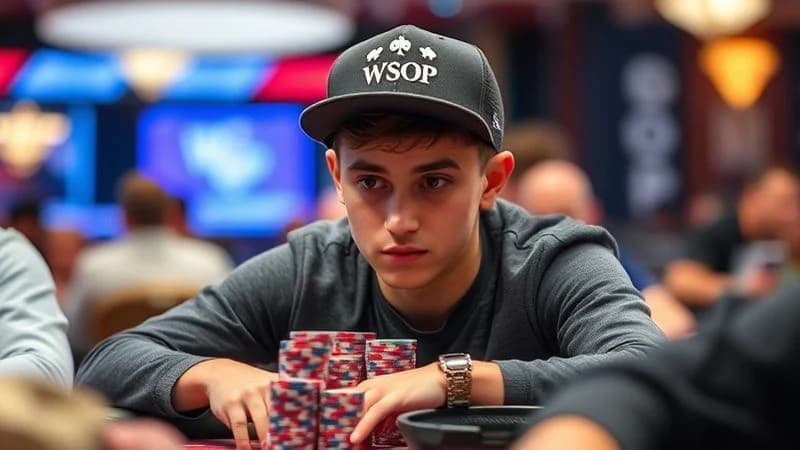
GCU Grad Leads WSOP Final Table
A graduate of Grand Canyon University GCU in Arizona currently leads a WSOP event final table, drawing attention. The competition is fierce as remaining players battle for the title and a substantial prize.

WSOP Misclick Jam with Pocket Aces Ends Up as Chip Leader
In a WSOP event, a player misclicked and jammed into an opponent's pocket aces, but hit a miracle river card to win a huge pot and take the chip lead. This dramatic moment became a hot topic at the tables.
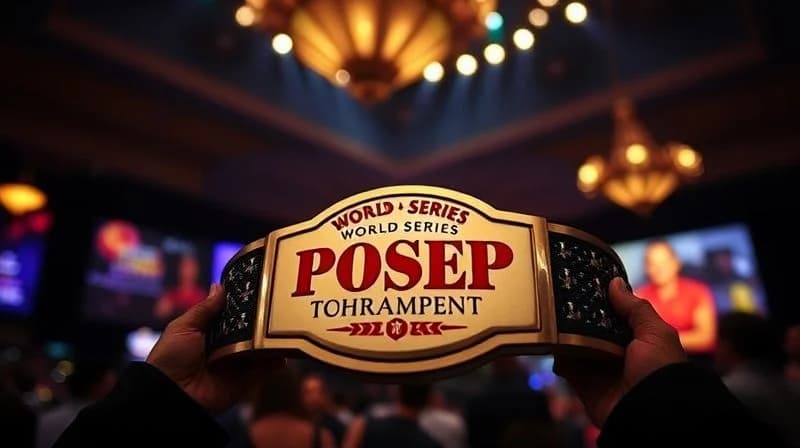
2026 WSOP: $10,000 Pot-Limit Omaha Championship Day 1 Kicks Off
Event 70 of the 2026 World Series of Poker WSOP — the $10,000 buy-in Pot-Limit Omaha PLO Championship begins Day 1. Hundreds of players entered, including many top professionals. The first day consisted of 8 levels with starting stacks of 50,000 and a tight blind structure. Several well-known players advanced, and Day 2 competition is expected to be even more intense.

Phil Hellmuth triples up in 2026 WSOP PPC after recovering from COVID
According to poker media reports, poker legend Phil Hellmuth successfully tripled his chips in the 2026 World Series of Poker WSOP Poker Players Championship PPC, marking a significant performance after his recovery from COVID-19.

Complete Guide to Super Satellites: Definitions, Strategies, and Common Misconceptions
Super satellites are a special type of qualifier in poker tournaments, designed to win seats to higher-value events with a lower buy-in. This article explains their definition, mechanics, core strategies, practical examples, and common misconceptions to help you efficiently use these events to reduce your tournament costs.

In the Money Turbo Strategy
After entering the money, the pace and strategy of the tournament fundamentally change. Turbo strategy emphasizes leveraging chip advantage, aggressive blind stealing, and adapting to fast blind levels to maximize final ranking and prize money. This article explains definitions, principles, practical examples, and common mistakes to help you improve your ITM stage performance.