Alex Theologis Launches ICM Course on
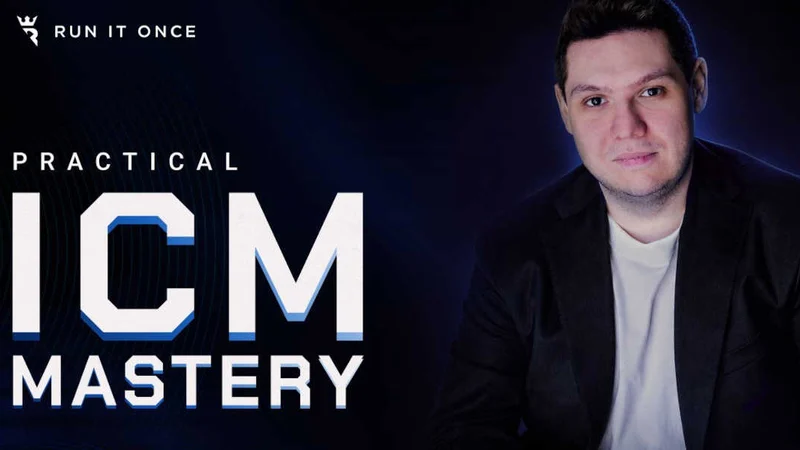
Poker coach Alex Theologis has released a practical ICM Mastery course on the Run It Once training platform, focused on tournament decision-making.
A New ICM Resource Lands on Run It Once
Poker coach Alex Theologis has released a training course titled Practical ICM Mastery on Run It Once, the online poker training platform founded by high-stakes professional Phil Galfond. The release adds another tournament-focused title to a site historically associated with cash-game strategy.
The course centers on ICM, short for the Independent Chip Model, one of the most consequential concepts in tournament poker and one of the most frequently misapplied.
What ICM Actually Measures
ICM is a mathematical model that converts a player's chip stack into its real-money equity in a tournament, based on the prize structure and the stacks still in play. The core insight is simple: chips are not linear in value. The last chip you win is worth less than the first chip you risk, because surviving into a higher payout tier has value independent of your stack size.
That non-linearity is why a chip-leader's stack is worth less in dollar terms than its proportion of the total chips in play, while a short stack's chips are worth proportionally more. It is also why ICM pressure is asymmetric: the player who can be eliminated has more to lose than the player who cannot.
Why Practical Application Is Hard
Most players understand the definition of ICM. Far fewer apply it correctly at the table, particularly under time pressure. Typical trouble spots include:
- Calling off on the bubble when the pot odds appear attractive but the payout jump makes the call clearly negative in equity terms
- Failing to widen shoving ranges when opponents are incentivized to fold
- Over-folding as a big stack when the risk of doubling up an opponent is overstated
- Ignoring pay jumps in the middle and late stages of a tournament, not just at the bubble
These errors are not conceptual failures so much as execution failures. Recognizing a high-ICM spot in real time, and adjusting ranges accordingly, requires repetition and structured review.
The Broader Training Context
Run It Once has built its reputation on cash-game instruction, with a roster of well-known professionals contributing strategy content. Adding a dedicated ICM course reflects the continued growth of tournament poker as a training market, driven in part by the popularity of large-field online and live tournament series.
For players already comfortable with basic push-fold charts, an ICM-focused course typically serves as a bridge between chart-based play and the more fluid adjustments required in deeper-stacked, post-flop tournament situations. The practical framing suggested by the course title implies an emphasis on application rather than pure theory.
What to Expect From ICM Training
Courses in this category generally cover the following ground:
- The underlying math of ICM and how equity shifts as stacks and payouts change
- Bubble factors and how they quantify risk premium in specific spots
- Adjustments to open, call, and shove ranges based on ICM pressure
- Final table dynamics, where pay jumps are largest and stack sizes most varied
- Common leaks and how to identify them in hand-history review
Players considering the course should note that ICM is a model, not a complete strategy. It assumes opponents play optimally and does not account for exploitative adjustments against specific player tendencies. Used alongside reads and population data, it becomes considerably more powerful.
Availability
Practical ICM Mastery is available through the Run It Once training platform. Pricing and subscription details are set by the platform and vary by membership tier.
FAQ
- ICM, or the Independent Chip Model, is a mathematical model that converts tournament chip stacks into real-money equity based on the prize structure and the stacks remaining in play. It reflects the fact that chips are not linear in value, since surviving into a higher payout has value on its own.