Jeju Poker Festival 2026
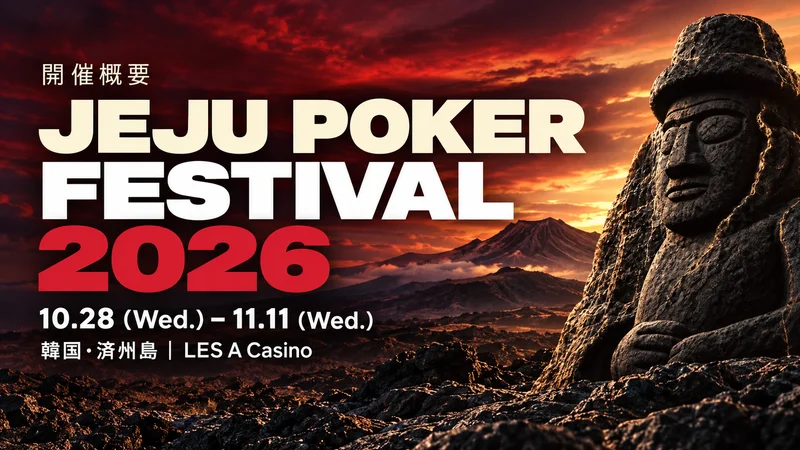
An overview of the Jeju Poker Festival 2026, covering its schedule, participation costs, and the structure of its three headline main events.
Jeju Poker Festival 2026 at a Glance
The Jeju Poker Festival 2026 is a poker tournament series scheduled to take place on Jeju Island, South Korea. The festival is organized around three headline main events, a structure that distinguishes it from series built around a single flagship tournament.
This overview covers what is publicly known about the festival's schedule, participation costs, and the three-main-event format. Because event details such as exact dates, individual buy-in amounts, and prize guarantees are typically confirmed closer to the festival, players should treat any figures they encounter as provisional until the operator publishes an official schedule.
Why Jeju as a Poker Destination
Jeju Island has become a regular stop on the Asian tournament circuit for several practical reasons.
- Visa access: Jeju allows visa-free entry for many nationalities for short stays, which lowers the barrier for players traveling from across Asia.
- Direct flights: The island has an international airport with connections to major Asian hubs, so travel does not require a mainland connection.
- Resort infrastructure: The island's resort and hotel capacity is built around tourism, which suits multi-day tournament schedules.
- Regional field: Events on Jeju typically draw a mix of local Korean players, Japanese players, and a broader international contingent, producing a field with a wide range of styles.
For players based in East Asia, this combination usually means lower travel costs and less administrative friction than a European or American series.
The Three Main Events
The defining feature of the Jeju Poker Festival 2026 is its three main events. In practice, a multi-main-event structure usually works in one of two ways.
Option One: Different Buy-in Tiers
The three mains sit at different price points, for example a lower-tier main, a mid-tier main, and a high-roller-style main. This lets a player choose a main event that matches their bankroll and still compete for a meaningful title. It also spreads the field: recreational players tend to concentrate in the lower tier, while the higher tier attracts more experienced and better-bankrolled entrants.
Option Two: Different Formats
The three mains use different formats, such as no-limit hold'em, pot-limit Omaha, and a short-handed or turbo variant. This appeals to players who want to test different skill sets within a single trip and gives the series a broader appeal than a hold'em-only schedule.
Whichever structure the operator uses, the practical consequence for players is the same: the festival offers more than one route to a headline result, and the choice of which main to play is a bankroll and format decision rather than a single fixed commitment.
Schedule and Participation Costs
A festival of this type is normally built around a multi-day schedule, with the three main events spaced across the series and side events filling the surrounding days. Side events commonly include smaller buy-in tournaments, satellites that award seats into the main events, and cash game tables running throughout.
Participation costs in poker tournaments are made up of two components:
- The buy-in, which is the amount a player pays to enter.
- The entry fee or rake, which the operator retains and which is not part of the prize pool.
When comparing events, the useful figure is the total cost to enter, not the headline buy-in alone. A tournament advertised at one price may carry an additional fee on top. Players should also account for the cost of re-entries if the event permits them, since a re-entry structure can substantially increase the total amount a player spends.
Satellites are the standard way to reduce the cost of entry into a main event. A satellite is a smaller tournament whose prize is a seat, or a package of seats, into a larger event. Winning a satellite typically costs far less than buying in directly, though the field is usually large relative to the number of seats awarded.
What to Confirm Before Booking
Because the specific dates, buy-in levels, and prize structures for the Jeju Poker Festival 2026 are set by the operator and can change, players planning to attend should verify the following directly with the official festival information before making travel arrangements:
- The confirmed dates of each of the three main events, not just the overall festival window.
- The total entry cost for each main event, including any fee on top of the advertised buy-in.
- Whether re-entry is permitted and under what conditions.
- The satellite schedule and what each satellite awards.
- Any guarantee attached to a prize pool, and the conditions under which a guarantee applies.
Summary
The Jeju Poker Festival 2026 is a Jeju Island series organized around three main events, with a schedule and cost structure that players should confirm against official information before committing to travel. The three-main format gives players a choice of buy-in level or format, and satellites offer a lower-cost route into the headline tournaments. As with any series, the total cost of participation is the buy-in plus fees plus any re-entries, not the advertised buy-in alone.
FAQ
- The festival is held on Jeju Island, South Korea. Jeju is a common stop on the Asian poker circuit partly because many nationalities can enter visa-free for short stays and the island has direct international flight connections.