Nipun Java on Bracelets, Burnout and
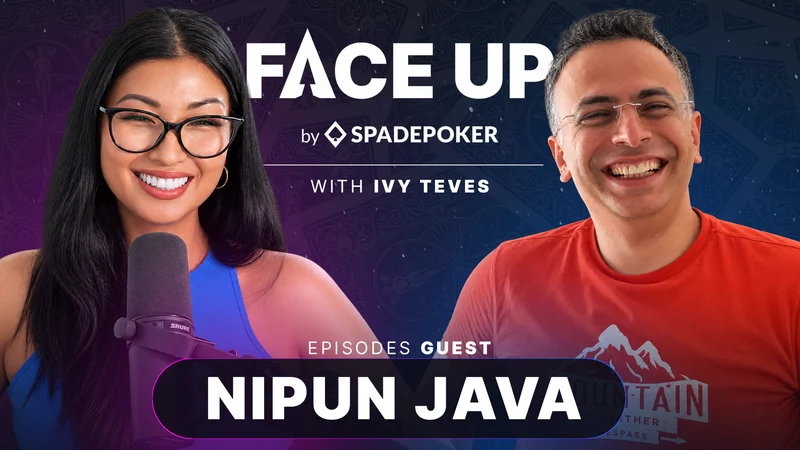
Nipun Java, the first India-born WSOP bracelet winner, discusses fading motivation, mental resilience, and what comes after a life built around poker.
Nipun Java's career follows a pattern familiar to many successful professionals: an initial obsession that becomes a daily grind, then a profession that delivers results, a WSOP bracelet, and financial independence. Today he plays far less volume and spends more time thinking about what he wants from the next phase of his life.
In the debut episode of the interview format Face Up with Ivy Teves, the conversation moves past table results toward motivation, mental resilience, generational change, and a question many professionals eventually face: what happens when the thing you have lived for no longer fulfills you the way it once did?
From Home Games to a Point of No Return
Java came up in an era when today's poker infrastructure barely existed. Solvers were not a standard part of study, and players learned from books such as Dan Harrington's tournament volumes, Doyle Brunson's Super/System, and Gus Hansen's Every Hand Revealed.
For someone with a technical background, poker was a natural extension of how he already thought: a problem to solve, a search for correct decisions, and a gradual edge over opponents.
A professional career did not arrive overnight. A turning point came after years of play, when Java posted two significant live scores in a short span. Around the same time, he obtained a green card, and his employer was looking for people willing to leave with severance. He applied almost immediately. As he describes it, results, a financial foundation, and administrative freedom arrived at once, allowing poker to become his profession for good.
A Historic Bracelet and a Career's Purest Memory
Success followed, making Java a prominent name in Indian poker. He became the first player born in India to win a WSOP bracelet, writing his name into the history of a scene that was only beginning its significant international growth.
When asked for his most powerful poker memory, Java does not mention the money or the celebration after the win. He recalls winning an online bracelet while staying in an Airbnb with a group of young players. The tournament ran late into the night, and his friends stayed with him until the end. After the victory, he went out for a smoothie at two in the morning because almost nothing else was open.
He describes that simple moment as one of the purest joys of his career: a time when the group was young, no one was yet spoiled by success, and poker was above all a shared adventure.
Young Players No Longer Fear Legends
Java draws a clear line between the generation he grew up with and today's young professionals. When he started, big poker names carried an aura of untouchability. A player could sit across from an established professional and invent a narrative in their own mind that the opponent knew something they could not comprehend.
Today the situation is entirely different. Daniel Negreanu vlogs daily life, professionals explain their strategy on podcasts, and the youngest players have access to solvers, AI tools, and training platforms from the start. According to Java, having the skill to beat someone is not enough; you also need the mentality that lets you truly believe you can beat them.
"Everyone gets two cards to play with," Java reminds listeners. The new generation does not have to wait years to realize that the big name across the table is not invincible.
The Greatest Poker Skill Is Not Visible in One Hand
What the public often underestimates in professional poker, Java argues, is not strategy but mental resilience. Unlike traditional sports, poker does not immediately reveal the physical difference between amateurs and professionals. Anyone can get two cards, win a single hand, or run deep in one tournament.
The difference emerges over the long term. A professional must return to the table after a series of losses, regulate emotions, and keep their game at least at a B-level instead of dropping to a D-game. Java considers the ability to handle losses and maintain decision quality amid unfavorable results one of the most crucial skills in the game.
An intriguing paradox sits inside the process of improvement. When you are losing, you have the greatest need to change something but the least mental capacity to absorb new information. When you are winning, you have the capacity but feel no urgency. One of his most significant career lessons is to learn to study and work on yourself during successful periods.
When the Obsession Fades
Motivation forms the core of the episode. Java admits that for years he treated his obsession with poker as automatic and permanent. The game fascinated him, he thought about it almost constantly, and that intensity allowed him to become a professional.
About three or four years ago, he felt something new: he was no longer in love with poker in the same way. The novelty had vanished, many goals were achieved, and he began asking what poker offered him beyond results and financial freedom. Java describes an uncomfortable contrast, in which his own desire to grind waned just as the game demanded more work.
Life Beyond Poker: Travel, Golf, and Real Connection
Today Java is far more drawn to travel that has nothing to do with the poker calendar. Looking back, he says that traveling for poker is not real travel. Flying to another country, spending all day in a casino, and having a few dinners after busting is not genuine exploration.
Paradoxically, he feels healthier, calmer, and mentally more stable on his own travels. He seeks nature, movement, and above all people. When Ivy asks what gives him the greatest feeling of truly living today, the answer has nothing to do with bracelets. It is authentic conversations. Java says he is fascinated by other people's life stories, their motivations, and the moments when they themselves do not know what comes next.
That interest is why he is considering poker coaching or a project that could pass on his experience. One possibility he mentions is a children's book based not on gambling but on the principles poker teaches: decision-making under uncertainty, handling losses, discipline, and learning from mistakes.
If Poker Disappeared Tomorrow?
One of the most powerful questions comes near the end of the interview. Ivy asks Java who he would be if poker simply ceased to exist tomorrow. His answer is candid: maybe it would be good if it disappeared. Part of him would feel relieved. He would no longer have to constantly decide whether to play more or less, whether he can find his passion again, and whether it is time for a completely new chapter.
Poker has given him financial independence, control over his own schedule, and the freedom to ponder questions that everyday life might not allow. Yet that freedom brings its own challenge: too much time and too little structure. Java acknowledges that without building a personal routine, a person can spend enormous amounts of time thinking without making any progress.
Don't Rush the Answer
His final advice is not about poker. Java directs it to people changing careers, feeling burned out, or simply unsure of what comes next. According to him, there is no point in forcing a major answer right away. It is better to fill your day with simple, repetitive activities: exercise, household chores, a walk, anything that creates a sense of stability and control.
When both body and mind are in good shape, Java believes the next path will reveal itself naturally. That may be what sets his current phase apart from his early poker days. Back then, he saw a problem and wanted to solve it immediately. Today, he is learning that some answers do not emerge from more study or greater volume. They simply need the space to appear.
FAQ
- Nipun Java is a professional poker player and the first India-born player to win a WSOP bracelet. He previously worked as an engineer before moving into poker full time.