Polish Grinder Emails Math to Dominate
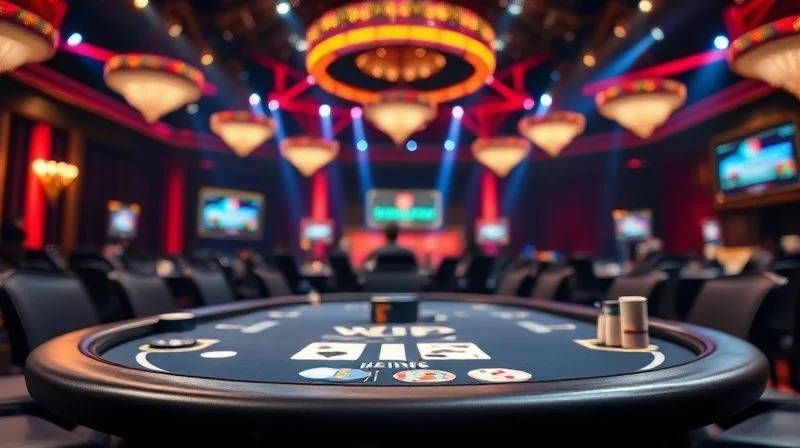
A Polish poker player uses rigorous mathematical analysis and strategic email exchanges to top the competitive WPT Asia leaderboard. This article reveals the methodology and practical wisdom behind it.
Polish Grinder Uses Emails and Math to Dominate WPT Asia Leaderboard
In the world of professional poker, top players often rely not only on talent and intuition but also on systematic mathematical tools and efficient communication strategies. Recently, a Polish poker player (often referred to as a "Grinder" by insiders) leveraged unique email analysis and mathematical modeling to climb to the top of the WPT Asia leaderboard, sparking热议 within the community.
Math: From Probability to All-Out GTO Strategy
This player is known for his solid mathematical foundation, particularly skilled in making decisions based on game theory optimal (GTO) strategy. While preparing for the WPT Asia series, he built probability models for different opponents' hand ranges and constantly optimized bet sizing and frequency by reviewing his own and his opponents' historical hands.
- Hand Range Training: He used mathematical software to simulate thousands of preflop and postflop scenarios, ensuring near-GTO decisions across different stack depths.
- ICM Pressure Testing: Once in the money, he focused heavily on practice with the Independent Chip Model (ICM) for bubble play, calculating the expected value (EV) of each decision to avoid common human errors.
Emails: A Strategy Workshop Across Time Zones
Beyond number crunching, this player gained valuable practical experience and psychological insights through email correspondence with top players worldwide.
- Opponent Analysis: He regularly emailed players who had faced WPT Asia participants, requesting insights into their typical betting patterns and bluffing tendencies. This first-hand data helped him formulate targeted counter-strategies in advance.
- Strategy Discussions: He established a small email group with like-minded players, sending hand histories after each event and discussing optimal lines using mathematical language. This asynchronous communication bypassed time zone barriers, allowing him to study Asian players' styles deeply while based in Europe.
Practical Fusion Application
In the race for the WPT Asia leaderboard, this player combined math with email insights to create a unique "dynamic adjustment system."
- Pre-Event Preparation: Based on intelligence gathered via email, he tweaked his default strategy in advance. For instance, learning that a well-known player had a wide button raising range, he increased his frequency of 3-Betting with medium pocket pairs from the small blind as a bluff.
- Mid-Session Real-Time Calculation: He carried a small notebook to quickly calculate pot odds, implied odds, and opponent range probabilities during breaks. This old-school "pencil-and-paper" method helped him avoid impulsive decisions in complex spots.
Lessons from Success
This player's story provides a clear growth path for amateurs: math forms the skeleton of poker, while information exchange forms the flesh. In today's information explosion, seemingly "outdated" tools like email actually enable deep thinking and the building of lasting personal networks.
Notably, such a rigorous system wasn't built overnight—he spent years testing and refining his methodology in lower-stakes events before his breakthrough on the WPT Asia stage.
Editor's Note: The player strategy described in this article is a typical example; actual results depend on multiple variables. Poker is a game of uncertainty; mathematical models can only improve long-term win rates, not guarantee short-term outcomes.
FAQ
- He primarily used Game Theory Optimal (GTO) strategies for hand range analysis, combined with Independent Chip Model (ICM) for payout structure decisions, while calculating the expected value (EV) of each bet through probability calculations.