Sarge Ferris: The Quiet Legend of Poker
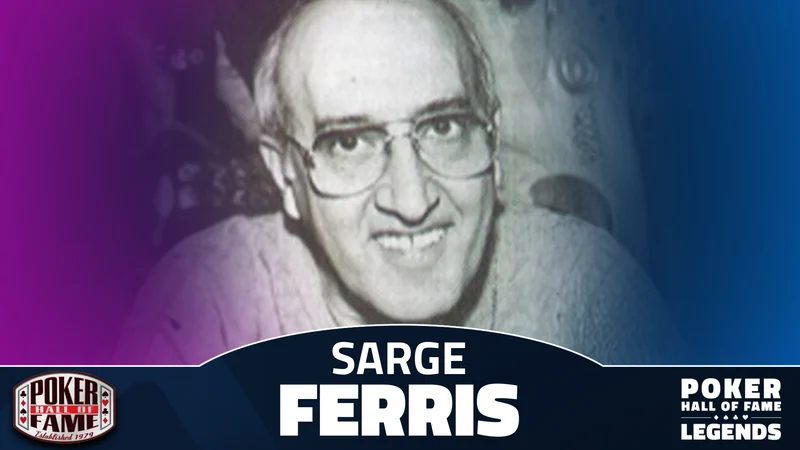
Fred "Sarge" Ferris was a fearless cash game player, a Poker Hall of Fame inductee, and the backer who helped launch Stu Ungar's legendary career.
Fred Bernard "Sarge" Ferris was not a man who chased the spotlight. In an era when poker was played in smoke-filled back rooms rather than on television, Ferris built a reputation as one of the most respected and feared cash game players in the United States. He was a contemporary and friend of Doyle Brunson, Billy Baxter, and other giants of the game, and he is remembered as the man who quietly helped launch the career of Stu Ungar.
From Poverty in Maine to the Nickname "Sarge"
Fred Ferris was born on December 1, 1928, in Waterville, Maine. He was the son of a Lebanese railroad worker, and his family endured severe poverty during his childhood. That experience taught him to value money without becoming attached to it, a lesson that later allowed him to play for enormous sums without hesitation.
He earned the nickname "Sarge" during his service in the U.S. Air Force. Although he left the military, the discipline and composure he developed there stayed with him for life.
The Road Gambler Years
In the 1940s and 1950s, Ferris worked as a classic road gambler, traveling through Texas, Louisiana, and Oklahoma to play in illegal games. In that dangerous environment, where cheating and violence were common, he built a reputation as an honorable man.
Ferris was known to have helped Doyle Brunson stay afloat during difficult times. When Brunson went broke on the road, Ferris lent him money without hesitation so he could get back into action. Their friendship was built on mutual respect and a shared love of poker.
In the 1960s, Ferris moved to Las Vegas, where he became a dominant force in Five Card Stud. By many accounts, he was considered among the best players of that variant in the country. In the 1970s, the biggest games in Las Vegas were not tournaments but cash games at the Dunes casino, organized by co-owner Syd Wyman, a 1979 Poker Hall of Fame inductee. With blinds of $1,000/$2,000, these games ran around the clock, and Ferris was one of the few players who could hold his own against elite competition like Brunson, Puggy Pearson, Jack Straus, and Bobby Baldwin.
His specialty was No Limit Deuce-to-Seven Draw, but he was willing to play any game. Billy Baxter once described him as a bulldog with a huge heart, noting that Ferris was not afraid of money. Whether he had $200 or $200,000 in his pocket, he would bet it all without blinking.
The Discovery of Stu Ungar
Perhaps the most significant moment of Ferris's life came in 1980, when he made a bold decision to pay the $10,000 buy-in for a 26-year-old from New York who had never played No Limit Hold'em before. That young man was Stu Ungar.
Ferris's judgment proved brilliant. Ungar went on to dominate the tournament and win his first world championship title. Without Ferris's backing and trust, the poker world might never have witnessed Ungar's genius.
WSOP Gold Bracelet
Although Ferris was primarily a cash game player, his talent also shone in tournaments. In 1980, he won a WSOP gold bracelet in a $10,000 No Limit Deuce-to-Seven Draw event. He defeated Doyle Brunson in heads-up play, with Bobby Baldwin finishing third. The victory confirmed his status as one of the best players in the world at that time.
Confrontation with the IRS and the "Taco Incident"
On April 22, 1983, Ferris was at the center of one of the most famous scandals in poker history. Agents from the Internal Revenue Service stormed the table during a game at Binion's Horseshoe casino and seized $46,000 in chips due to tax arrears. According to popular accounts, after taking his money, one of the agents tossed him back a $25 chip and mockingly told him to "buy a taco."
Because Ferris had Lebanese heritage and was often assumed to be Hispanic, many people, especially in the local Hispanic community, perceived the remark as a racist insult. Ferris, however, remained completely composed. It later emerged that the agent was merely suggesting dinner at a Mexican restaurant inside the casino where Ferris regularly dined. The moment became a perfect illustration of his character: calm even when authorities were taking away his bankroll.
The Final Game and Eternal Fame
Fred "Sarge" Ferris lived poker to the very end. He passed away on March 12, 1989, at the age of 60. In a symbolic turn, his heart gave out just hours after he finished a high-stakes game.
A few months later, in December 1989, Ferris was posthumously inducted as the 18th member of the Poker Hall of Fame. Though he never sought fame or publicity at the table, his contribution to the game, his courage, and his honor earned him a place among the immortal.
Fred "Sarge" Ferris remains remembered as the man who "wasn't afraid of money" and who quietly influenced the paths of some of the greatest names in poker history.
FAQ
- Fred Bernard "Sarge" Ferris was an American professional poker player, a renowned cash game specialist, and a 1989 inductee into the Poker Hall of Fame. He was known for his fearlessness, his integrity, and his role in backing Stu Ungar's early career.