In the Money
Editor: dezhoupuke.orgRelated Glossary
MTT
MTT
Players accumulate chips by eliminating opponents, until one player wins the championship. In practice, an MTT tests a …
Final Table
Final Table
Final Table The final table is the final stage of a Texas Hold'em tournament where all remaining players are consolidat…
Bubble Factor
Bubble Factor
In practice, it helps players adjust their decisions near the money: when the Bubble Factor is greater than 1, the actu…
ITM
ITM
The practical significance of this term is that it marks a shift from simply competing for rank to securing profit. It …
Final Table Bubble
Final Table Bubble
In practice, the player in this position faces immense psychological pressure: due to the significant prize jump (the m…
Free Roll
Free Roll
Pay Jump Ladder
Pay Jump Ladder
The pay jump ladder is the structure of increasing prize amounts for each finishing position in a poker tournament, whe…
Min-Cash Zone
Min-Cash Zone
The Min-Cash Zone is the stage in a poker tournament near the money bubble where players adjust their strategy to survi…
In the Money
In the Money
In a poker tournament, In the Money ITM refers to the point at which a player's finish position guarantees a cash prize…
ICMizer
ICMizer
ICMizer is a poker software tool that calculates Independent Chip Model ICM equity and provides recommended strategies …
Double or Nothing
Double or Nothing
A tournament format where half the field finishes in the money, each receiving exactly double their buy-in minus rake, …
Equity Share
Equity Share
The portion of the total prize pool or pot that a player is entitled to based on their current equity, often calculated…
Related Strategy
ICM Bubble Strategy Guide: The Art of Protecting Chips and Precision Attacks
The bubble phase of poker tournaments is a critical profit stage. This article details how the ICM model influences decisions, teaching you to adjust preflop ranges, leverage stack depth and position advantages, and maximize ICM equity while avoiding elimination. Includes practical examples and common mistake analysis.
Tournament Bubble Phase Stealing Blinds Strategy
The bubble phase of a tournament is a critical stage for profit. This article delves into how to exploit opponents' tight-passive tendencies under ICM pressure and accumulate chips through a reasonable blind-stealing strategy. It covers position selection, stack size analysis, range adjustments, and practical considerations to help you safely expand your advantage during the bubble.
Tournament Bubble Steal Strategy: Theory and Practical Guide
The tournament bubble is a critical phase for profitability. Stealing blinds effectively accumulates chips. This article explains the principles of bubble stealing, position selection, chip stack considerations, opponent tendency identification, and adjustment methods to help you make optimal decisions under pressure and increase your chances of reaching the money.
Tournament Pay Jump Ladder Decisions: How to Maximize Your Expected Value
This article analyzes the ICM pressure caused by pay jumps in the late stages of tournaments, providing a practical decision-making framework including folding to secure advancement, timing calculations for aggressive chip accumulation, and how to balance EV with survival.
Blind Stealing Strategy in Tournament Bubble: How to Exploit Opponents' Fear for Profit
During the tournament bubble, many players tighten their ranges due to fear of elimination, creating excellent opportunities for aggressive blind stealing. This article details hand selection, bet sizing, positional advantages, and counter-strategies to help you maximize chip gains during the bubble.
Bubble Stealing Strategy in Tournaments: How to Maximize ICM Value
The tournament bubble phase is when ICM pressure is at its highest, and a correct blind-stealing strategy can significantly improve your win rate. This article systematically explains how to efficiently steal blinds during the bubble from perspectives such as hand selection, position utilization, opponent reading, and counter-stealing responses, while avoiding risks and maximizing chip value.
Tournament Bubble Near Pay Jump Strategy: How to Maximize Rewards Approaching the Money
During the tournament bubble, especially near significant pay jumps, players must shift from regular play to ICM-oriented strategy. This article details attack and defense techniques for different stack sizes, adjustments to steal and defend ranges, and how to exploit opponents' fear to gain value, helping you survive the bubble safely and aim for higher payouts.
Tournament Bubble Stealing Strategies: Improve Survival Rate and Accumulate Chips
During the tournament bubble period, correctly using stealing strategies can significantly improve your survival rate and accumulate chips. This article will introduce the concept of the bubble, opponent range analysis, timing and frequency of steals, risk control, and counter-stealing responses, helping you make optimal decisions at critical moments.
Blind Stealing Strategy on the Tournament Bubble: How to Build Chips Under Pressure
During the tournament bubble, blind stealing is a key method to accumulate chips. This article analyzes ICM pressure, position, and opponent ranges, providing a specific execution framework and common mistakes to help you make correct decisions in tense moments.
Deep Stack Tournament Preflop Wide Range Strategy: When to Tighten, When to Loosen
In the deep stack phase of tournaments usually over 100BB, preflop ranges can be moderately widened to exploit implied odds, but need to be dynamically adjusted based on position, opponents, and ICM pressure. This article systematically explains how to build profitable wide ranges from aspects such as scenario description, ICM factors, specific strategic frameworks, key decision points, and common mistakes.
Efficient Blind Stealing Strategy During Tournament Bubble
The tournament bubble is a critical phase for accumulating chips, and blind-stealing strategies need to incorporate ICM pressure and opponent behavior. This article starts with scenario explanations and pressure factor analysis, providing a specific framework, key decision points, and common mistakes to help players maximize blind-stealing profits on the bubble.
Profit Secrets of Japanese Poker Pros: From Style to Strategy
Japanese poker players are known for their discipline, aggression, and mathematical precision. This article analyzes their common styles and distills core strategies for practical use, including range management, exploitative adjustments, and tournament ICM techniques, helping you replicate the thinking of top Japanese players at the tables.
Related Players
' width='512' height='512'/%3E%3Ctext x='256' y='256' text-anchor='middle' dominant-baseline='central' font-family='system-ui,sans-serif' font-size='240' font-weight='bold' fill='hsl(198,30%25,85%25)'%3EAD%3C/text%3E%3C/svg%3E)
Andrea Dalle Molle
 Italy
Italy
Andrea Dalle Molle, Italian poker player, mainly active in online tournaments, multiple WSOP cashes, total earnings over $110,000.
' width='512' height='512'/%3E%3Ctext x='256' y='256' text-anchor='middle' dominant-baseline='central' font-family='system-ui,sans-serif' font-size='240' font-weight='bold' fill='hsl(312,30%25,85%25)'%3EKH%3C/text%3E%3C/svg%3E)
Kenta Honke
 Japan
Japan
Kenta Honke is a professional poker player from Japan, known for his online poker tournament performances. He has participated multiple times in top events such as the World Series of Poker WSOP and has cashed in the Main Event. His playing style is considered aggressive, and he is one of the representative figures in the Japanese poker community.
' width='512' height='512'/%3E%3Ctext x='256' y='256' text-anchor='middle' dominant-baseline='central' font-family='system-ui,sans-serif' font-size='240' font-weight='bold' fill='hsl(275,30%25,85%25)'%3ECS%3C/text%3E%3C/svg%3E)
Cody Slaubaugh
 United States
Cody Slaubaugh is an American professional poker player ranked #2304 in the world with career live tournament earnings exceeding $1.3 million. Known for his consistent cashes in World Series of Poker events, he maintains a low-profile, disciplined approach to the game.
' width='512' height='512'/%3E%3Ctext x='256' y='256' text-anchor='middle' dominant-baseline='central' font-family='system-ui,sans-serif' font-size='240' font-weight='bold' fill='hsl(209,30%25,85%25)'%3ENC%3C/text%3E%3C/svg%3E)
Nicholas Carballo
United States
American poker player, accumulates prize money through online and live events, multiple WSOP in-the-money finishes, stable style.
' width='512' height='512'/%3E%3Ctext x='256' y='256' text-anchor='middle' dominant-baseline='central' font-family='system-ui,sans-serif' font-size='240' font-weight='bold' fill='hsl(267,30%25,85%25)'%3EKC%3C/text%3E%3C/svg%3E)
Kyu Cho
United States
Kyu Cho, American poker player, world ranking 20708, career total earnings $158,245. Has cashed in multiple events including WSOP, specializes in No-Limit Hold'em.
' width='512' height='512'/%3E%3Ctext x='256' y='256' text-anchor='middle' dominant-baseline='central' font-family='system-ui,sans-serif' font-size='240' font-weight='bold' fill='hsl(297,30%25,85%25)'%3EDK%3C/text%3E%3C/svg%3E)
Danny Kaminsky
United States
Danny Kaminsky, American poker player, world rank 29679, career total earnings $107,459. Known for a solid style, he has cashed multiple times in WSOP and other events.
' width='512' height='512'/%3E%3Ctext x='256' y='256' text-anchor='middle' dominant-baseline='central' font-family='system-ui,sans-serif' font-size='240' font-weight='bold' fill='hsl(167,30%25,85%25)'%3EHS%3C/text%3E%3C/svg%3E)
Hien Scott Nguyen
United States
Hien Scott Nguyen, American poker player, world ranking 32057, career earnings $96,198, known for consistent performance and cashing in multiple tournaments.
' width='512' height='512'/%3E%3Ctext x='256' y='256' text-anchor='middle' dominant-baseline='central' font-family='system-ui,sans-serif' font-size='240' font-weight='bold' fill='hsl(270,30%25,85%25)'%3EAF%3C/text%3E%3C/svg%3E)
Aidan Ferguson
United States
American poker player, world ranking approximately 37259, total earnings $80,689, has won small tournament championships.
Related Events
Main Event 316 - $1,100 Main Event
Location: The Venetian Las Vegas; Buy-in: $1,100; Guaranteed Prize: $1,000,000; Source: Mid-States Poker Tour
WPT Prime Cyprus Championship
Part of the WPT Prime series, buy-in $1,100, held in Cyprus, offering players a low-stakes WPT tournament experience.
Triton PLO Main Event
Triton Poker, in collaboration with WSOP, hosts a high-stakes Pot-Limit Omaha main event in the Bahamas with a buy-in of $100,000, providing a high-level competitive platform for top PLO players.
Super Colossus NLH
Location: Bahamas; Buy-in: $5,000; Source: WSOP Paradise
Kings of Tallinn Mini Main Event
Location: Tallinn, Estonia; Buy-in: €550; Guaranteed prize pool: €200,000; Source: Kings Casino Poker Series
EuroPoker Circuit France Lyon
The EuroPoker Circuit France Lyon, sponsored by Winamax, will be held June 10-14, 2026. The main event has a €500 buy-in and features fun formats like Mystery Ace, offering European players a high-value poker experience.
Event #6: $3,000 No-Limit Hold'em Six-Handed
Early event in WSOP series, with six-handed fast pace, buy-in $3,000, suitable for players who like short-handed strategy.
WSOP Event 8: $50,000 NLH High Roller
High buy-in no-limit hold'em event in the WSOP series, attracting top professionals and high-stakes players, competing for gold bracelet honors.
Related News

WSOP Main Event Enters Day 4 as the Money Bubble Looms in Las Vegas
The 2025 WSOP Main Event in Las Vegas has reached its fourth day, with remaining players approaching the money bubble. As the bubble nears, the tournament pace tightens, and players face critical decisions.

WSOP Player Championship Bubble: Only One Past Champion Still Fighting
The 2025 WSOP Player Championship PPC enters the bubble stage, with many top players eliminated. Only one past champion remains at the table, fighting for a chance to enter the money.
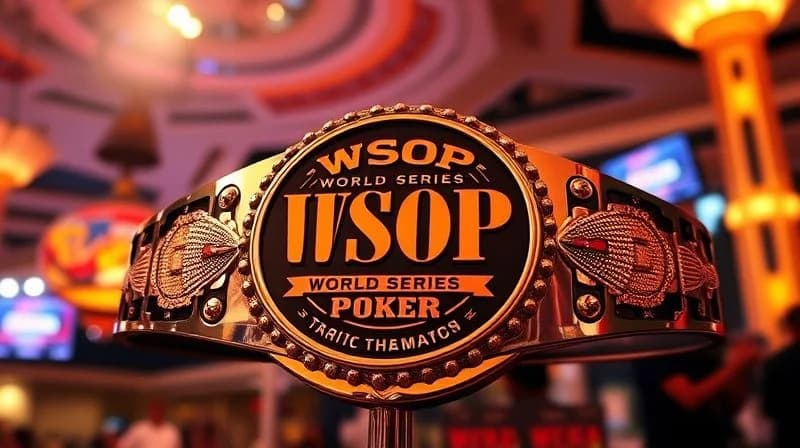
Halfway Review: Highlights and Regrets of the First Half of the 2026 WSOP
The 2026 World Series of Poker WSOP is halfway through, with 49 events completed. This article reviews the highlights and low points of the first half: Negreanu and Hellmuth got off to slow starts, the Fergusons each won a gold bracelet, Mateos won his sixth career title, and Kihara achieved a double victory.

WSOP 2026: Sammartino Sixth Cash, Marcucci 74th
In a controversial event at WSOP 2026, Italian player Dario Sammartino made his sixth cash, while fellow Italian Marcucci finished 74th. Details of the event are still being disclosed.

Tournament Bubble Strategy: How to Exploit Opponents' Prize Money Pressure for Advantage
During the bubble phase of poker tournaments, many players become conservative due to their desire to cash. Based on the analysis of poker coach Marcelo Fonseca, this article explains how to use aggressive strategy against opponents crushed by the prize money pressure to maximize your chip stack and winning chances.

Approximately 15 Ukrainian Players Expected to Make Money in WSOP Main Event
According to Ukrainian media Tribuna.com, approximately 15 Ukrainian players are expected to finish in the money ITM in the 2025 WSOP Main Event. The report is based on historical data and participation trends, highlighting the continued growth of Ukrainian poker strength.

Mystery Bounty Late Stage Strategy Guide
In-depth analysis of the unique strategies for the late stages of Mystery Bounty tournaments, including ICM pressure, bounty value assessment and adjustment, and key decision points in actual play.

Mystery Bounty ITM Strategy
Mystery bounty tournaments, after reaching the money ITM, shift strategic focus from chip accumulation to protecting chips and pursuing high-value eliminations. This article explains definitions, principles, practical examples, and common misconceptions to help players make optimal decisions.

Late-Stage Bounty Strategy: Maximizing Elimination Value and ICM Trade-offs
In the late stages of bounty tournaments, players must balance direct bounty rewards with ICM Independent Chip Model pressure. This article details the bounty value formula, range adjustments, real-world decisions, and common pitfalls to help readers make optimal choices on the bubble.

Hyper Turbo Late Stage Strategy Guide: From Theory to Practice
In-depth analysis of unique strategies for late stages of hyper-turbo tournaments, including ICM pressure, preflop all-in range adjustments, blind stealing and re-stealing techniques, and common pitfalls, helping you profit steadily in high volatility.

In the Money Turbo Strategy
After entering the money, the pace and strategy of the tournament fundamentally change. Turbo strategy emphasizes leveraging chip advantage, aggressive blind stealing, and adapting to fast blind levels to maximize final ranking and prize money. This article explains definitions, principles, practical examples, and common mistakes to help you improve your ITM stage performance.

In-the-Money Satellite Strategy
The goal of a satellite tournament is to win a main event ticket, not to maximize chips. The strategy for making the money emphasizes survival first; ICM has a significant impact, requiring adjustments to the typical aggressive style of regular tournaments. This article explains definitions, principles, practical examples, and common misconceptions.