Doyle Brunson
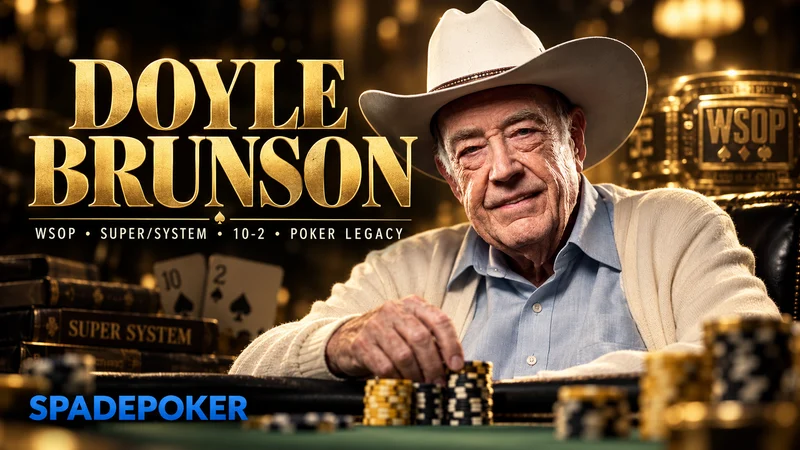
Doyle Brunson won 10 WSOP bracelets, back-to-back Main Events in 1976 and 1977, a WPT title, and wrote Super/System, shaping modern poker.
Doyle Brunson was one of the most important poker players who ever lived. Known as "Texas Dolly" and widely called "The Godfather of Poker," Brunson helped shape professional poker before television, before online poker and before the modern World Series of Poker became a global sports event.
His career stretched across generations. He played in dangerous road games across Texas and the American South. He competed in the first World Series of Poker in 1970. He won back-to-back WSOP Main Events in 1976 and 1977. He collected 10 WSOP bracelets, won a World Poker Tour title, played some of the biggest cash games in Las Vegas and wrote Super/System, one of the most influential poker strategy books ever published.
And somehow, one of the weakest starting hands in Texas Hold'em became permanently connected to his name. Ten-deuce. The Doyle Brunson hand.
Who Was Doyle Brunson?
Doyle Brunson was an American professional poker player born on August 10, 1933, in Longworth, Texas. He became one of the central figures of poker's early professional era and was inducted into the Poker Hall of Fame in 1988. The WSOP officially lists him as a 10-time bracelet winner and credits him with helping shape the tournament from its earliest years.
Brunson's career was unusual because it did not belong to only one period. He was already a professional gambler before the WSOP existed. He remained relevant through the television poker boom of the 2000s and was still competing in major events decades after his first bracelet. Few players ever connected poker's old road-gambler era with the modern professional game as directly as Doyle Brunson.
Why Was Doyle Brunson Called Texas Dolly?
The nickname "Texas Dolly" came from a misunderstanding. Brunson explained that Jimmy "The Greek" Snyder used to call him "Texas Doyle." Reporters misheard the nickname as "Texas Dolly," published it that way, and the name stuck. Brunson never planned the nickname. But it became one of the most famous names in poker history.
Doyle Brunson's Early Poker Career
Before Las Vegas became the center of poker, Brunson made his living as a travelling gambler. The official WSOP biography describes him playing in illegal games across Texas, Oklahoma and Louisiana, part of a dangerous road-gambling culture where professional poker was very different from the regulated casino environment that later developed.
These games helped build the qualities that defined Brunson's career. He needed to understand people. He needed discipline. He needed the ability to handle extreme financial swings. And he needed the confidence to play large pots against opponents who were often just as experienced. That background later became central to the image of Brunson as one of poker's ultimate old-school professionals.
Doyle Brunson and the First WSOP
Doyle Brunson competed in the first World Series of Poker in 1970. The inaugural WSOP included early legends such as Johnny Moss, Amarillo Slim, Puggy Pearson and Brunson himself. Johnny Moss was selected as the first Main Event champion.
At the time, the WSOP was nothing like the modern festival. There were no thousands of Main Event players, no global livestream audience and no enormous tournament schedule. But Brunson was there from the beginning. That alone makes his career historically significant.
How Many WSOP Bracelets Did Doyle Brunson Win?
Doyle Brunson won 10 WSOP bracelets. The official WSOP all-time bracelet standings list him among only a small group of players to reach double-digit bracelet totals. His 10 bracelets came across several different poker formats, including No-Limit Hold'em, Seven Card Stud, Razz, H.O.R.S.E. and 2-7 Draw.
That versatility matters. Brunson was not a one-game specialist. He was part of a generation expected to play almost everything.
Doyle Brunson's 10 WSOP Bracelets
- 1976: $5,000 No-Limit 2-7 Draw Lowball
- 1976: $10,000 WSOP Main Event
- 1977: $10,000 Seven Card Stud Hi-Lo
- 1977: $10,000 WSOP Main Event
- 1978: $5,000 Seven Card Stud
- 1979: $600 Mixed Doubles Seven Card Stud
- 1991: $2,500 No-Limit Hold'em
- 1998: $1,500 Razz
- 2003: $2,000 H.O.R.S.E.
- 2005: $5,000 No-Limit Hold'em 6-Handed
WSOP records confirm the 10 bracelet victories and show how extraordinary Brunson's longevity was. His first bracelet came in 1976 and his final bracelet came in 2005, nearly three decades later.
Back-to-Back WSOP Main Event Wins
Doyle Brunson won the WSOP Main Event in both 1976 and 1977. Back-to-back Main Event victories are among the rarest achievements in poker history. Only a handful of players have ever done it, including Johnny Moss, Stu Ungar, Johnny Chan and Brunson.
But Brunson's victories became even more famous because of the cards he held in the final hands. In both championships, he won with ten-deuce. That coincidence created one of poker's most famous hand nicknames.
Why Is 10-2 Called the Doyle Brunson Hand?
Ten-deuce is called the Doyle Brunson hand because Brunson won the WSOP Main Event in consecutive years with the same starting hand. He won the 1976 Main Event holding 10-2, and then won the 1977 Main Event with 10-2 again. The official WSOP biography still highlights the coincidence as one of the defining stories of his career.
Ten-deuce is not considered a strong starting hand. That is exactly why the story became so memorable. Today, poker players around the world still refer to 10-2 as "the Doyle Brunson."
Doyle Brunson and Super/System
Doyle Brunson changed poker away from the table as well. His book Super/System became one of the most important poker strategy books ever published. The WSOP dates its publication to 1978, while contemporary Card Player coverage often refers to the commercially released book as appearing in 1979. Either way, the book emerged at the end of the 1970s and fundamentally changed access to professional poker knowledge.
That was revolutionary. Professional players had traditionally protected their strategic knowledge. Brunson did the opposite. He gathered elite players and published advanced ideas about multiple poker formats for the wider public. Players such as Chip Reese contributed specialized strategy to the book.
Why Super/System Changed Poker
Super/System mattered because it made elite poker thinking available to ordinary players. Before books like this, much of serious poker strategy was learned through expensive experience. Brunson and his contributors explained how top professionals thought about aggression, starting hands, position, betting and different poker variants.
The effect was so significant that Brunson later joked that publishing the book may have cost him money because it helped opponents improve. The WSOP still describes Super/System as one of the most impactful poker books ever produced.
Doyle Brunson's Tournament Earnings
Doyle Brunson recorded more than 6.17 million dollars in live tournament earnings. Hendon Mob currently lists him with 6,176,737 dollars in total live earnings and a biggest recorded cash of 1,198,260 dollars.
Those numbers need historical context. Brunson played much of his career before modern super high rollers, seven-figure tournament buy-ins and enormous Main Event fields. Raw tournament earnings therefore do not fully measure his poker career. His reputation was built heavily in cash games.
Doyle Brunson's Biggest Live Tournament Cash
Brunson's biggest recorded live tournament cash came in 2004. He won the World Poker Tour Legends of Poker Main Event for approximately 1.198 million dollars. The official WPT results list Brunson as champion for 1,198,290 dollars.
The victory showed that Brunson was still capable of winning major events decades after his first WSOP titles. That kind of longevity is one of the strongest parts of his career.
Doyle Brunson and the World Poker Tour
Doyle Brunson won one World Poker Tour title. His victory came at the 2004 WPT Legends of Poker, where he defeated Lee Watkinson heads-up and collected nearly 1.2 million dollars. The WPT also records more than 2 million dollars in Brunson's career winnings on the tour.
This period mattered because it connected Brunson directly to the television poker boom. He was not simply a legend from the 1970s. He was still competing against modern tournament professionals.
Doyle Brunson's Cash Game Legacy
Cash games were central to Doyle Brunson's identity. Hendon Mob's biography notes that despite his tournament success, Brunson was known for concentrating heavily on cash games and regularly playing some of the highest stakes available in Las Vegas.
This is why tournament earnings tell only part of the story. Private and casino cash games are not tracked through one complete public database. A player can spend decades winning and losing enormous sums without those results appearing on Hendon Mob. For Brunson, the cash-game reputation was every bit as important as his tournament resume.
Doyle Brunson Net Worth
Doyle Brunson's exact net worth was never publicly verified through an audited financial record. That makes confident internet estimates difficult to support.
We know he earned more than 6.17 million dollars in recorded live tournaments. We know he spent decades in high-stakes cash games. We know he earned money through books, poker-related business activity and sponsorships. But those facts do not create an exact net worth figure.
Tournament winnings are gross payouts, not personal wealth. Cash-game results, taxes, investments, business income and liabilities are not fully public. The responsible conclusion is that Brunson was financially successful over an extraordinarily long poker career, but his exact net worth cannot be verified from public records.
Doyle Brunson's Poker Style
Brunson represented aggressive old-school poker. His strategy rewarded pressure, initiative and reading opponents. That philosophy became one of the defining themes of Super/System.
But Brunson was not simply reckless. His longevity suggests the opposite. Surviving decades in high-stakes cash games requires bankroll management, emotional control, game selection and the ability to adjust as poker strategy evolves. That adaptability helped Brunson remain relevant long after the game around him changed.
Doyle Brunson and the Godfather of Poker Image
Brunson was frequently called "The Godfather of Poker." The nickname reflected more than age. It reflected his position in the history of the game. He had been there before poker became mainstream. He helped build the WSOP era. He taught strategy through Super/System. He competed through the television boom. And younger generations of elite professionals continued to treat him with respect. The official WSOP profile still identifies Brunson as "The Godfather of Poker."
Doyle Brunson in the Poker Hall of Fame
Doyle Brunson was inducted into the Poker Hall of Fame in 1988. By then, his career already included two Main Event titles and multiple bracelets. But his legacy continued growing for decades after his induction. He eventually reached 10 WSOP bracelets, won a WPT title and remained part of the biggest poker games in Las Vegas. The Hall of Fame induction therefore came long before his career was finished.
Doyle Brunson's Family and Todd Brunson
Poker also became part of the Brunson family. Doyle's son Todd Brunson built a successful professional career of his own. Todd became a WSOP bracelet winner and was inducted into the Poker Hall of Fame in 2016.
FAQ
- Doyle Brunson won 10 WSOP bracelets, with his first in 1976 and his last in 2005.