Nate Silver: Poker, Intuition and
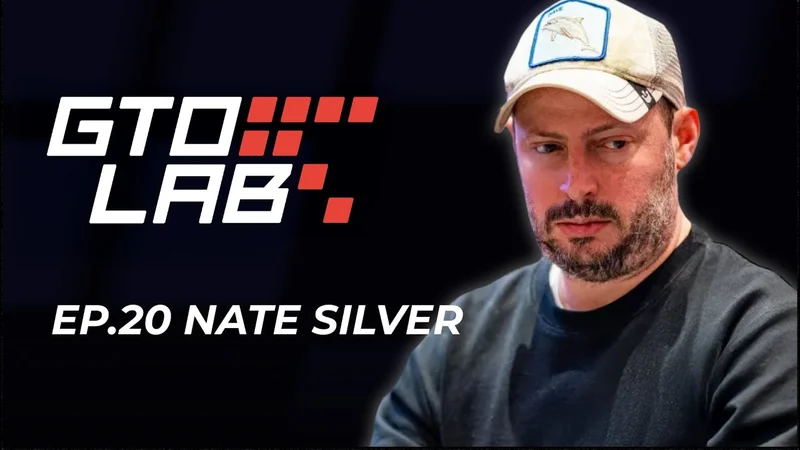
Nate Silver discusses poker as a controlled addiction, why intuition can beat solvers, and how excessive optimization can harm players.
Nate Silver is best known for building prediction models and founding FiveThirtyEight, but poker has run through his career from the beginning. Before his media years, he played professionally, mainly online limit hold'em, at stakes that were among the highest available on the internet at the time. Later, as an employee of a major sports network that broadcast the World Series of Poker, he found it awkward to play the series himself. Around 2021, he began returning to the game more seriously and noticed a shared mindset among poker players, venture capitalists, finance professionals, sports bettors and AI researchers. He calls this mindset "The River."
Expected Value as a Way of Life
For poker players, expected value is second nature. The goal of a hand is not simply to win the pot in front of you, but to make the decision with the highest long-term value. Silver says he applies the same thinking to daily life. When booking a flight, he weighs not only the ticket price but also how many productive hours he might lose by waking up early. In his writing, he may ask what another hour on an article could return in new subscribers.
This willingness to quantify the seemingly unquantifiable links many people in the River world. Poker, however, has one crucial advantage over other fields: mistakes cost players directly. Make poor decisions long enough and your bankroll shrinks. In politics, business or investing, feedback is slower and fuzzier, and failures are often explained away by external factors. Poker forces players to update their worldview regularly.
Solvers Measure Progress, but Not the Most Important Kind
Silver is not anti-solver. He uses them and openly says he still needs to study areas such as ICM. His concern lies elsewhere. Poker players naturally love things that can be measured. If training software lifts a score from 91 to 93, the player feels immediate progress. Yet a higher score does not necessarily mean the biggest leak in their game has been fixed.
Silver argues that players sometimes obsess over tiny differences in GTO strategy while much larger exploitative opportunities sit unnoticed at the table. If a live spot is dramatically under-bluffed, the correct fold may matter far more than a perfect understanding of blocker effects inside a tight solver mix. In his own study, he prefers to use solvers as a sandbox rather than a memorization tool. He examines the same board at 20, 40, 100 and 200 big blinds, changes one card or one sizing, and watches how the strategy shifts. The goal is not to memorize the answer but to build heuristics that can be applied in real time.
When Data Is Not Enough, Intuition Steps In
It may seem odd for a data specialist to advocate intuition, but Silver argues that as the fundamental technical principles of the game become solved, more value can be found in elements a model cannot see. Live reads. Timing. History with an opponent. Their current emotional state. The way they checked.
Silver describes avoiding overthinking during strong play, trying to stay in a state where information is processed naturally. Instead of explicitly running through five heuristics in his mind, he sometimes simply feels that one part of a mixed strategy carries more weight in a given spot. This raises an obvious problem: how do you distinguish genuine intuition, built from experience, from a mere desire to do something entertaining? A player might have a "feeling" they want to bluff, when in reality they are bored, want to win a pot, or want to bust a tournament so they can go to dinner. Telling those impulses apart is another level of poker decision-making.
Poker as Chasing the Dragon
One of the most compelling parts of the discussion is why people play live tournaments at all. A tournament player loses the majority of the time. Even highly skilled professionals can have losing years according to simulations, and live variance can stretch into extreme periods. Silver recalls a deep run in the 2023 WSOP Main Event, reaching the sixth day, yet he does not describe the experience as an outright positive memory.
That is why he likens poker to chasing the dragon. At high stakes, even the body reacts. Silver mentions his first experiences with $50/$100 and higher no-limit cash games, where the sensation of risk was almost narcotic. An increased heartbeat or stress is not automatically a problem. The body should know you are playing higher than usual. If the reaction is controlled, it can push a player into a state of extreme focus.
Why Poker Cannot Be Infinitely Optimized
Throughout the conversation, Silver often thinks in terms of EV. Yet he admits that applying the same logic to everything can be a recipe for a miserable life. When you are self-employed, there is always another article to write, another hour that could bring subscribers, another tournament with positive EV. At some point, even optimization itself becomes suboptimal.
The same applies to poker. Silver does not have to play the toughest $10K tournament just because it is more challenging. Sometimes he chooses a softer $1K event where he can play and leave whenever he wants. He does not always maximize poker EV. Sometimes he prioritizes life EV.
That makes Silver an intriguing figure for a poker podcast. His career is built on data, probability and models, yet after decades with the cards, he still returns to what the model can never fully capture: people, intuition, motivation, flow, and the right moment to stop calculating and simply play the hand.
FAQ
- It is his term for the shared mindset among poker players, venture capitalists, finance professionals, sports bettors and AI researchers who habitually think in terms of expected value and quantify uncertain outcomes.