Poker Skills That Carry Over to
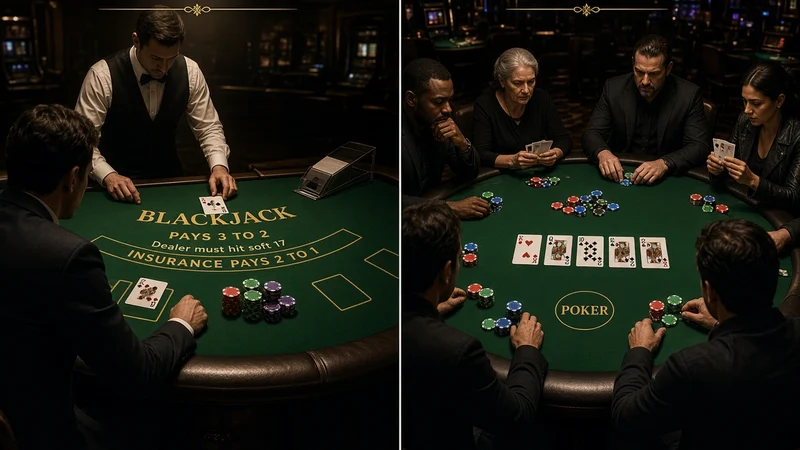
Poker players moving to blackjack keep probability sense, bankroll discipline, and emotional control, but hand reading, bet sizing, and bluffing no longer apply.
Blackjack and poker share a surface resemblance. Players receive cards, place bets, and try to win the hand. Beyond that, the two games diverge sharply. Blackjack is a casino table game played against the house, with fixed rules and a defined optimal strategy. Poker is a game played against other people, where opponents adjust, bluff, and exploit each other.
For poker players curious about blackjack, the transition is usually straightforward. Blackjack is widely available at casinos and online platforms, and online versions often offer a wider variety of rulesets and stake levels. Some skills transfer directly. Others are irrelevant. Understanding which is which helps a poker player approach the blackjack table with realistic expectations.
Probability Awareness Transfers Directly
Poker trains players to think in terms of odds and equity. Calling a bet means weighing the price against the chance of winning the hand. That habit of probabilistic thinking carries over to blackjack.
In blackjack, the core decision is whether to hit, stand, double, or split. The strength of your hand is compared against the dealer's visible upcard to estimate the probability of winning by standing versus the risk of taking another card. The math is simpler than in poker, and the correct play is largely fixed.
Basic strategy charts outline the optimal move for every combination of player hand and dealer upcard. Memorizing these charts is the standard route to playing the game well. Unlike poker, where opponents change their behavior, blackjack decisions are static and odds-based. There is no need to adjust for a tricky opponent or a table image.
Decision Making Under Time Pressure
Both games require decisions within a time limit. In poker, players often have a time bank, especially online, and can face a clock call if they take too long. In blackjack, the dealer moves around the table asking each player how they want to act. On your turn, you need to be ready.
Poker players are already accustomed to acting promptly under pressure. That habit helps at the blackjack table, where slowing down the game is frowned upon. The decisions themselves are simpler, but the pace is steady and continuous.
Bankroll Management Still Matters
Bankroll management is a core discipline for serious players in any casino game. The principle is straightforward. Set aside funds used only for playing, and make sure that money is an amount you can comfortably afford to lose. Then play at stakes well within your limits.
A common example is a player with a $100 bankroll choosing $1 stakes across many hands rather than risking the full amount in one or two bets. Spreading play over many hands smooths out variance and extends playtime. For winning poker players, bankroll management is a way to reduce the risk of going broke, and it often involves moving up or down in stakes as the bankroll changes.
Blackjack carries a small house edge, but the same philosophy applies. Playing at very low stakes relative to your overall bankroll lets you play hundreds of hands, practice basic strategy, and keep the session enjoyable. The goal is not to chase losses but to give yourself enough hands to apply correct decisions consistently.
Emotional Control Is Essential
Poker demands emotional control. Knowing the right move is one thing; applying it after a bad beat or during a downswing is another. Every poker player knows the feeling of going on tilt and how quickly it can lead to losing chips.
Blackjack also requires emotional control. Sticking to basic strategy means making the correct move according to your hand and the dealer's upcard, not acting on intuition, anger, or fatigue. Emotional control also supports bankroll management. The worst response to a losing session is to fire up more games or move up in stakes.
Skills That Do Not Carry Over
Poker players develop skills that have no place in blackjack. Hand reading, bet sizing, and bluffing opponents off their cards are central to poker success. In blackjack, you are not competing against other players. You only need to consider the dealer's upcard, and the dealer follows fixed rules, such as standing on 17 in most games.
There is no opponent to psychoanalyze and no need to balance ranges. The optimal play in blackjack is purely odds-based and static. All you have to do is learn basic strategy and apply it correctly. For many poker players, that is part of the appeal. Blackjack is a more relaxed game with less mental load.
Making the Transition
The transition from poker to blackjack is easy for players who already understand probability, manage their bankroll, and keep their emotions in check. The skills that do not transfer, such as hand reading and bluffing, are simply set aside. What remains is a game where the correct decision is defined in advance, and discipline matters more than creativity.
For poker players looking to branch out, blackjack offers a familiar casino environment with a lower mental burden. The key is to respect the house edge, stick to basic strategy, and treat the game as a test of discipline rather than a battle of wits against other players.
FAQ
- Probability awareness, bankroll management, decision making under time pressure, and emotional control all transfer well. Hand reading, bet sizing, and bluffing do not apply because you play against the dealer, not other players.