Comparing Top Poker Solvers in 2026
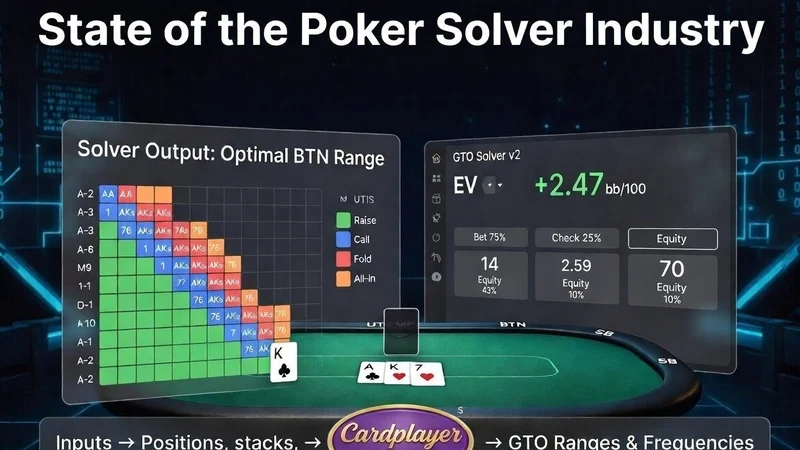
A side-by-side look at the most popular poker solvers in 2026, covering pricing, features, and which player types each tool suits best.
Poker solvers have become a standard part of the serious player's toolkit. These programs calculate GTO (Game Theory Optimal) solutions for preflop and postflop spots, helping players build strategies that are difficult to exploit. While a segment of the poker community still does not endorse solvers, most professional players treat them as a natural step in the game's evolution. At high stakes, especially online, a solver-based foundation is often considered close to mandatory.
Most solvers share the same core function, but each offers a different mix of features, pricing, and usability. The right choice depends on your experience level, the games you play, and how you study. Below is a comparison of the leading options available in 2026.
What a Poker Solver Does
A solver takes the parameters of a spot — stack depths, positions, bet sizes, and ranges — and calculates an equilibrium strategy. The output is not a guarantee of profit, but a baseline that cannot be exploited by a perfectly informed opponent. Players use solvers to review hands, drill decisions, and identify leaks.
Modern solvers fall into two broad categories. Some, like PioSolver, build custom solutions on your own hardware. Others, like GTO Wizard and Octopi Poker, are web-based and rely on large libraries of pre-solved spots. Each approach has trade-offs in computing power, cost, and depth of study.
Top Solvers at a Glance
- GTO Wizard — Released 2020. From about $26 per month billed annually. NLHE. Best for intermediate to advanced cash and tournament players. Known for multi-way solutions.
- Octopi Poker — Released 2023. About $16.67 per month billed annually. NLHE. Best for beginners through advanced players. Known for its Vault and interactive hand trainer.
- PioSolver — Released 2015. One-time fee of about €450. NLHE. Best for advanced players who want deep, custom study.
- PeakGTO — Released 2025. About $59 per month billed annually. NLHE. Best for intermediate tournament players. Known for interactive drills.
- Railbird — Released 2026. About $30 per month for the Starter version. NLHE. Best for novice and intermediate cash game players. Known for a simple interface.
- GTO Lab — Released 2025. About $74 per month billed annually. NLHE. Best for intermediate tournament players studying ICM spots.
- PLO Mentor — Released 2026. About $7 per month. PLO. Best for novice to advanced PLO players. Known for low cost.
- Vision — Released 2020. About $249.75 per month billed annually for the full version. PLO and PLO5. Best for intermediate to advanced PLO players.
- PokerSnowie — Released 2013. About $16.66 per month billed annually. NLHE. Best for beginners and intermediate players. Known for being cheap and easy to use.
GTO Wizard
GTO Wizard is one of the most established names in the solver market. It offers a large library of pre-solved spots — reported at over 10 million — covering various stack depths and formats including cash games, MTTs, heads-up, and SNGs. Its practice tool allows random scenarios or custom spots with instant feedback street by street. Analysis tools let players upload their own hands and receive GTO reports.
In 2025, GTO Wizard added the ability to solve three-way spots, a feature most competitors do not yet offer. The software calculates on the fly and returns solutions quickly. The trade-off is complexity: the platform is not considered beginner-friendly. New users may feel overwhelmed by the number of charts and options. Tutorials and FAQs exist, but the depth of the software makes simplicity difficult. Pricing is tiered, and a limited free mode is available.
Octopi Poker
Octopi Poker is a newer entrant that has gained momentum. Created by Victoria Livschitz, it combines a solver engine with tools aimed at beginners and casual players. Its solver features include a large library of pre-solved simulations with options for different stack sizes, ICM spots, and final tables; a hand trainer with real-time decision ratings; and an analyzer for importing hands and comparing them to GTO solutions.
The interface is designed to be user-friendly, fitting everything on a single screen with hover pop-ups for ranges. Unique features include the Range Map, which shows how ranges change around the table, and the Vault, a growing database of real hands played by top pros in major live tournaments. Each Vault hand is analyzed, playable from any seat, and paired with a video clip. Pricing is a simple personal or professional subscription, with the professional tier giving full access.
PioSolver
PioSolver, released in 2015, was one of the first true solvers and remains relevant. Unlike most modern solvers, it builds custom solutions based on user input. This requires more computing power — at least an i7 processor and about 16GB of RAM — and is not web-based. It is designed for advanced players who want to break down specific spots in detail. The interface feels dated compared to newer tools, but it is functional. There is no subscription; a license covers two computers, with Pro and Edge options. Edge offers the highest customization, including custom compiles for specific hardware.
PeakGTO
PeakGTO comes from the team behind Pokercoaching.com. It offers a library of millions of pre-solved hands across positions and stack depths from 10 to 200 big blinds, a trainer with over 20 million solutions, hand-picked drills, a daily drill, and a leak finder. It was developed primarily for tournament players, though it works for cash games above 100 big blinds. An ICM module is included. The interface was updated in September 2026 and is simple and intuitive. A limited free membership is available, followed by a single subscription tier.
Railbird
Railbird is one of the newest options, combining traditional solver outputs with AI capabilities. It targets both beginners and experienced players, with a focus on novice and intermediate cash game players. Its Starter version is priced at about $30 per month. The platform emphasizes a simple, intuitive user interface.
GTO Lab, PLO Mentor, Vision, and PokerSnowie
GTO Lab focuses on tournament players and is particularly suited for studying ICM spots, priced at about $74 per month billed annually. PLO Mentor offers PLO study at about $7 per month, aimed at novice to advanced PLO players. Vision is a Pot Limit Omaha solver covering PLO and PLO5, priced at about $249.75 per month billed annually for the full version, aimed at intermediate to advanced PLO players. PokerSnowie, released in 2013, is a cheap and easy-to-use NLHE option at about $16.66 per month billed annually, best for beginners and intermediate players.
How to Choose
Beginners should prioritize usability and cost. PokerSnowie, Octopi Poker, and Railbird are often recommended for those new to solvers. Intermediate players may want a balance of features and price, making GTO Wizard, PeakGTO, or GTO Lab strong candidates. Advanced players who want deep, custom analysis may prefer PioSolver. PLO specialists should look at PLO Mentor or Vision.
No solver plays the game for you. The value comes from consistent study, honest review of your own hands, and applying what you learn at the table.
FAQ
- A poker solver is software that calculates Game Theory Optimal (GTO) strategies for preflop and postflop spots based on parameters like stack depth, positions, and bet sizes.