Learning Mixed Games Beyond Hold'em
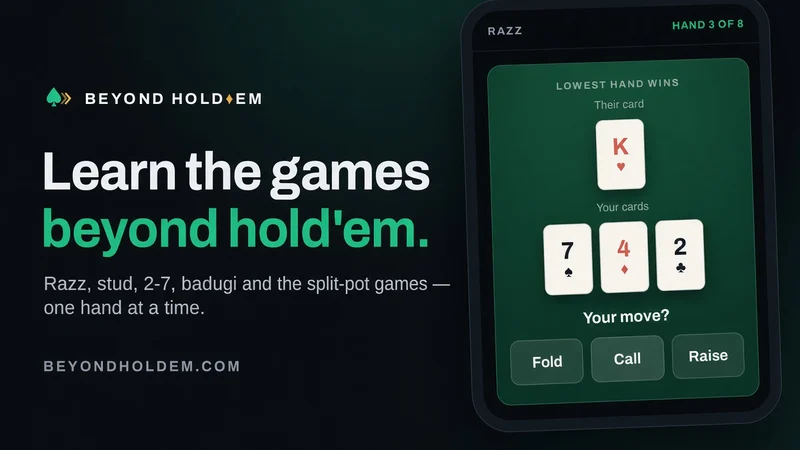
Mixed games are spreading in card rooms, but strategy resources lag far behind hold'em. A new trainer teaches Razz, Stud, Badugi and more by making you decide first.
The Gap Between Knowing Rules and Knowing What to Do
Almost every player who sits down in a first mixed game hits the same moment. The dealer announces the next round is Razz, the cards come out, and it becomes clear that knowing the rules and knowing what to do are two different skills. You understand that the lowest hand wins, but you have no idea whether the hand in front of you is actually good.
The rules of Razz take about 90 seconds to explain. Everything after that — which starting hands are playable, what an opponent's up-card tells you, when to fold a hand that looks fine — is the part that is rarely taught, and it is the part that costs money.
Why Mixed Game Resources Are So Thin
Hold'em has an enormous library behind it: training sites, solvers, hand history reviews, and decades of books. Mixed games have a fraction of that online training content plus a handful of books, most written for players who are already competent. Very little assumes you are starting from zero.
That makes economic sense. Hold'em has more players. But it leaves an odd situation: mixed games are spreading, with more rotations in card rooms and more variety on festival schedules, while the on-ramp for learning them has barely changed. Players show up to a mix knowing the rules of six games, at best, and the strategy of one.
Decide First, Explain Second
The core design choice behind one new trainer, Beyond Hold'em, is simple: you make the decision before you get any advice. A hand appears. In Razz, you see your cards and the opponent's up-card. You choose fold, call, or raise. Only then does the coach tell you what the right play was and why, in a sentence or two of plain language rather than a chart.
This is deliberate. Reading strategy content teaches you to recognize a spot after someone else has framed it for you. Being asked to commit first, and being wrong, teaches something different, because you find out exactly where your instinct was off. It is closer to how you learn at a table, minus the part where being wrong costs a buy-in.
Each game has a guided path of lessons built this way, and each lesson is a themed set of hands: starting hands, reading up-cards, when to break a made hand, when to stop drawing. After the lessons, you can play hands against bots in the same game and get the same explanation on every decision.
What makes it a trainer rather than a quiz is that the hands never run out. Nothing comes from a fixed bank of puzzles you can memorize. Every hand is dealt fresh from a shuffled deck, and the coach grades whatever the cards produce. In heads-up Razz alone there are more than a million distinct third-street spots — your three cards against one opponent's door card — before fourth street is even dealt. You can play a thousand hands and keep seeing spots that are new to you, which is how pattern recognition actually builds.
What Decides the Right Answer?
Each game has a rules engine behind it. The engine reads the live cards, works out what is dead and what you are drawing at, prices the decision against the pot, and returns one move along with the reasoning for it. In a growing share of spots it goes further: it weighs what the opponent's betting says they are likely holding, works out how often your hand wins against that, and compares it with the price.
This is not a solver in the GTO sense. A solver asks what is unexploitable against a perfect opponent and answers in frequencies, for example raising a hand 63 percent of the time. That is the right tool for a hold'em player working on a specific spot, and the wrong tool for someone learning what a good Badugi hand even is. The engines here ask a narrower question: what is correct here, given what is visible and what it costs. That question has a single answer, and it can be explained in a sentence. Where strong players genuinely split between two plays, the engine still gives one answer and grades the other as close rather than wrong.
Razz Example: 7-4-2 Against a King
You hold 7-4-2 and your opponent's up-card is a king. You pick raise, call, or fold. The engine looks at three cards to a seven, checks which of the cards you need are already showing around the table and therefore dead, and weighs that against the only thing the king tells you: that this opponent is starting badly. The answer comes back: raise. Three cards to a seven against a king is ahead of anything they can hold right now, and you would rather play it heads-up. The reasoning is the part that transfers. Next time you see a nine showing instead of a king, you already know which way the comparison moves.
Badugi Example: Calling a Player Who Drew 3-1-1
Your opponent drew three cards, then one, then one. You have a jack Badugi, not a good one, and they bet. Here the engine barely looks at the quality of your hand at all. It counts draws. Three-one-one means they were still drawing at the end, and a one-card draw to a badugi misses roughly three times out of four. The answer: call. They needed that last card. When it does not come they have a three-card hand, and a jack badugi beats every hand that did not get there.
Notice what that reasoning does not depend on: a read on this particular opponent. You are not calling because you think he is capable of firing; you are calling because most of the time he simply does not have a badugi, and a weak one beats no badugi at all. Where bluffs do matter, as they do on a stud river, the coach does not guess about the person across from you. It assumes a sound player, one who bets strong hands and bluffs with the draws that missed, and asks whether the call pays against that. "Would he really bluff there?" is exactly the question a new player has no way to answer, so the coach never asks it.
Built With Players Who Play the Games
An engine can do the arithmetic. What it cannot pick up on its own is the feel of each game: that a Razz hand's value depends as much on what is dead as on what you hold, that a rough badugi is a call against a player still drawing and a fold against one who stood pat, that a hand which is technically fine in Stud 8-or-Better gets you scooped in practice. That kind of knowledge comes from playing, and no amount of simulation replaces it.
So every game's logic and coaching is reviewed by mixed game regulars and pros who play these games for real money, and their feedback has changed plenty of answers. The usual pattern is a line that is technically defensible but is not what a strong player would actually do. That is exactly the kind of mistake a bot cannot catch on its own, and one a new player would never know to question.
Every change is also measured before it ships. A new answer is played against the old one over 100,000 simulated hands, the same hands dealt to both, and it goes in only if it does not lose chips. Some do not make it: a Stud bring-in defense that looked right on paper lost money in that test and was left out.
Games and Cost
Six games are covered at the moment: Razz, Seven-card Stud, 2-7 Triple Draw, Badugi, Omaha Hi-Lo, and Stud 8-or-Better. It runs in a browser with no download or install. The intro lessons in every game are free, and so is all Razz play, so you can get a genuine sense of whether the approach works for you before paying anything. All Access is $9.99 a month and unlocks play across all six games. There is also a free Daily Hand if you just want one spot to think about.
If you have been meaning to learn the games in the rotation, Razz is a reasonable place to start. It is free, and you will know within ten hands whether this way of learning works for you.
FAQ
- A solver asks what is unexploitable against a perfect opponent and answers in frequencies, such as raising a hand a certain percentage of the time. A trainer for mixed games asks a narrower question: what is correct here, given what is visible and what it costs. That question usually has a single answer that can be explained in a sentence.