Range
Editor: dezhoupuke.orgRelated Glossary
Range Check Flop
Range Check Flop
A strategy where a player checks their entire range on the flop, typically from out of position, to counteract opponent…
Range Bet Turn
Range Bet Turn
A continuation bet made on the turn with a very high frequency often 100% of one's range, typically in positions where …
Range Bet Flop
Range Bet Flop
A strategy where the preflop aggressor bets with their entire range on the flop, often on boards that favor their range…
Range Check Turn
Range Check Turn
A strategy where the player who was the aggressor on the flop checks their entire range on the turn, rather than contin…
Value Heavy Range
Value Heavy Range
A range of hands that contains predominantly strong value hands with very few or no bluffs, indicating the player is li…
Range Advantage Turn
Range Advantage Turn
The strategic edge a player holds on the turn because their overall hand range is stronger than the opponent's, often d…
Top of Range
Top of Range
The strongest hand or hands within a player's range of possible holdings in a given situation.
Middle of Range
Middle of Range
The set of hands in a player's range that are neither the strongest top of range nor the weakest bottom of range, typic…
Range Morph
Range Morph
Range Morph is the strategic adjustment of a player's hand range to an opponent, often to exploit perceived weaknesses …
Expanded Range
Expanded Range
In poker, an expanded range refers to a player's hand range that is wider than their typical or default range, often ad…
Condensed Range
Condensed Range
A range composed primarily of medium-strength hands with similar equity, lacking clear polarization between very strong…
Uncapped Range Advantage
Uncapped Range Advantage
Uncapped Range Advantage refers to the strategic edge a player holds when their range contains the strongest possible h…
Related Strategy
Polarized vs Merged Betting Range: Strategy Principles and Practical Applications
A polarized range consists of strong value hands and bluffs, while a merged range includes medium-strength hands. This article explains their definitions, applicable scenarios, advantages and disadvantages, and how to adjust based on opponents to optimize your betting strategy.
Overbet Usage Timing and Range Construction Techniques
Overbet is an efficient polarized betting strategy in poker, suitable for specific board textures, opponents, and stack depths. This article explains when to use overbet, how to construct balanced value and bluff ranges, and provides practical examples and common mistake analysis.
Application of Range Advantage and Nut Advantage: The Core of Postflop Decision Making in Texas Hold'em
This article delves into the definitions, differences, and practical applications of range advantage and nut advantage. Through preflop range construction, flop texture analysis, and typical strategy adjustments, it helps players accurately assess their advantage in postflop decisions, thereby formulating exploitative bet sizing and frequencies to increase win rate.
A-High Flop Strategy: How to Utilize Range Advantage and Polarized Betting
A-high flops are one of the most common board structures in Texas Hold'em. This article explains, from the perspectives of both the preflop raiser and the caller, how to leverage range advantage, select bet sizing, balance value and bluffs, and respond to opponents' counterplays. The examples are clear, suitable for intermediate players looking to improve their flop decision-making.
CO Steal vs BB Defense: Range Construction and Postflop Strategy
In-depth analysis of CO and BB preflop and postflop confrontation strategies, including standard steal ranges, defense ranges, postflop pot control and attack techniques, as well as adjustment methods for different opponents.
Detailed Explanation of SB Limp and Raise Strategy in Heads-Up
In heads-up pots, limping from the small blind is a common play, but how should you respond when facing a raise? This article analyzes the SB's response to a BB raise from the perspectives of range construction, exploitative strategy, and balance, helping you make better decisions in heads-up play.
Exploitative Application of Range Morphing: How to Counter Opponents' Adjustments
This article introduces the concept of range morphing and focuses on how to actively induce opponents to adjust and then counter them in exploitative strategies. By adjusting your own bet sizing, frequency, and range composition, you cause opponents to misjudge and make incorrect decisions, thereby greatly increasing your win rate. Includes real combat scenarios and adjustment examples.
Short Deck 6+ Preflop Range Adjustment: Transitioning Preflop Strategy from Regular Texas Hold'em to Short Deck
Short Deck 6+ Short Deck has a dramatically different hand strength structure due to the removal of 2-5. This article, starting from positional scenarios, provides recommended preflop ranges raising ranges, calling ranges, explains the construction logic in detail, analyzes adjustment factors (effective stacks, opponent tendencies, table dynamics), references GTO, and offers practical application suggestions to help you quickly adapt to Short Deck preflop play.
Deep-Stacked Cash Game Preflop Range Construction Strategy
This article explains in detail the preflop range construction logic for deep-stacked cash games 200BB+, covering opening, calling, and 3-bet strategies from different positions, analyzing the impact of stack depth on ranges, and providing GTO references and practical adjustment suggestions.
Deep Stacked Cash Game Preflop Range Construction: Position and Adjustment Guide
In deep stacked cash games >150BB, increased implied odds require significant adjustments to preflop strategy. This article details recommended raising and calling ranges by position, incorporating adjustments based on equity realization, stack depth, opponent tendencies, and other factors. It provides GTO reference benchmarks and a practical application framework to help players optimize decisions in deep stack scenarios.
Small Blind Balanced Strategy: Building Offensive and Defensive Ranges
The small blind is one of the toughest positions preflop. This article explains how to build balanced 3-bet and calling ranges, including adjustments against different opponents, frequency references, and practical examples to help you make better decisions from the small blind.
Small Blind Balanced Range Construction: A GTO Practical Guide
Using the small blind as an example, this guide explains how to construct a balanced preflop range. It covers position scenarios, recommended hand types, range construction logic, adjustment factors, GTO references, and practical applications to help players achieve balanced offense and defense in the small blind and improve long-term profitability.
Related Players
' width='512' height='512'/%3E%3Ctext x='256' y='256' text-anchor='middle' dominant-baseline='central' font-family='system-ui,sans-serif' font-size='240' font-weight='bold' fill='hsl(188,30%25,85%25)'%3ENL%3C/text%3E%3C/svg%3E)
Nikita Luther
 India
India
Nikita Luther is one of India's most representative female poker players, transitioning from online poker to international stages. She is known for her stable performances and breakthrough achievements, most notably winning a WSOP bracelet in a team event, making her the first Indian woman to earn a WSOP gold bracelet.
' width='512' height='512'/%3E%3Ctext x='256' y='256' text-anchor='middle' dominant-baseline='central' font-family='system-ui,sans-serif' font-size='240' font-weight='bold' fill='hsl(175,30%25,85%25)'%3ETH%3C/text%3E%3C/svg%3E)
Thomas Hueber
 Austria
Austrian professional poker player, known for his solid style, has cashed in many large tournaments.
' width='512' height='512'/%3E%3Ctext x='256' y='256' text-anchor='middle' dominant-baseline='central' font-family='system-ui,sans-serif' font-size='240' font-weight='bold' fill='hsl(333,30%25,85%25)'%3EIC%3C/text%3E%3C/svg%3E)
Ionut Coman
 United Kingdom
Ionut Coman is a professional poker player from the United Kingdom, known for his online high-stakes and tournament results, with an aggressive style and good use of position.
' width='512' height='512'/%3E%3Ctext x='256' y='256' text-anchor='middle' dominant-baseline='central' font-family='system-ui,sans-serif' font-size='240' font-weight='bold' fill='hsl(326,30%25,85%25)'%3EAP%3C/text%3E%3C/svg%3E)
Artur Palaj
United Kingdom
Artur Palaj is a professional poker player from the UK, known for his solid performance in high-stakes cash games and tournaments. He excels in deep stack strategy and exploitative play, enjoying a reputation as a low-key but powerful player in the community.
' width='512' height='512'/%3E%3Ctext x='256' y='256' text-anchor='middle' dominant-baseline='central' font-family='system-ui,sans-serif' font-size='240' font-weight='bold' fill='hsl(305,30%25,85%25)'%3EKJ%3C/text%3E%3C/svg%3E)
Kristy Jonkergouw
 Netherlands
Kristy Jonkergouw is a poker player from the Netherlands, known for her consistent performance in cash games and tournaments. She is often seen as one of the representatives of the female poker community, with an aggressive and observant style.
' width='512' height='512'/%3E%3Ctext x='256' y='256' text-anchor='middle' dominant-baseline='central' font-family='system-ui,sans-serif' font-size='240' font-weight='bold' fill='hsl(161,30%25,85%25)'%3EDN%3C/text%3E%3C/svg%3E)
Dmytro Nikolaiev
 Ukraine
Dmytro Nikolaiev is a professional poker player from Ukraine, known for his performance in online high-stakes games and live tournaments. He has earned the respect of his peers with his aggressive and flexible playing style.
' width='512' height='512'/%3E%3Ctext x='256' y='256' text-anchor='middle' dominant-baseline='central' font-family='system-ui,sans-serif' font-size='240' font-weight='bold' fill='hsl(344,30%25,85%25)'%3ETP%3C/text%3E%3C/svg%3E)
Timothy Pai
 United States
Timothy Pai is an American professional poker player with lifetime tournament earnings of $985,919, built primarily through consistent online results. He is recognized for a tight-aggressive style and disciplined bankroll management, and he has also shared preflop range charts that have helped recreational players.
' width='512' height='512'/%3E%3Ctext x='256' y='256' text-anchor='middle' dominant-baseline='central' font-family='system-ui,sans-serif' font-size='240' font-weight='bold' fill='hsl(263,30%25,85%25)'%3EMR%3C/text%3E%3C/svg%3E)
Mitchell Range
United States
Mitchell Range is a poker player from the United States, active in online and live tournaments, known for his solid fundamentals and steady style.
Related Events
Event #4: $10,000 No-Limit Hold'em Heads-Up
This event is the fourth in the series, featuring a $10,000 buy-in No-Limit Hold'em heads-up knockout format. Heads-up play tests players' reading skills, adjustment techniques, and psychological battles, making it one of the most spectator-friendly forms of poker tournaments.
Event #6: $3,000 No-Limit Hold'em Six-Handed
Early event in WSOP series, with six-handed fast pace, buy-in $3,000, suitable for players who like short-handed strategy.
Related News

Where to Play Poker Near Rugby: Coventry vs Leicester Casino Guide
Compare the best casinos near Rugby for poker. We break down Coventry and Leicester options, travel times, and what to expect at each venue.
Study Ranks Las Vegas Hotels by Cleanliness During WSOP 2026
A new study ranks Las Vegas hotels by cleanliness during WSOP 2026, helping poker players choose the cleanest stays. Find out which hotels topped the list.
Study Ranks Las Vegas Hotel Cleanliness During WSOP 2026
A new study ranks Las Vegas hotels by cleanliness during WSOP 2026, offering insights for poker players seeking hygienic stays.
ICOOP 2026: Italian Online Poker Championship Returns September 6 on PokerStars, Snai, and Sisal
ICOOP 2026, Italy's premier online poker championship, kicks off September 6 on PokerStars, Snai, and Sisal. Details on schedule, events, and how to participate.
Best Live Casino Sites for US Players: A Live Dealer Deep Dive
We tested live dealer floors at five US-facing casinos. High limits, stream quality, and mobile play compared. Lucky Rebel leads for whales, Ignition for variety.

Q8 Suited: A Player's 'Lucky Hand' and the Reality of Poker Superstitions
A poker player calls Q8 suited their 'luckiest hand,' but is it really lucky? We explore the math, variance, and why players develop superstitions at the table.
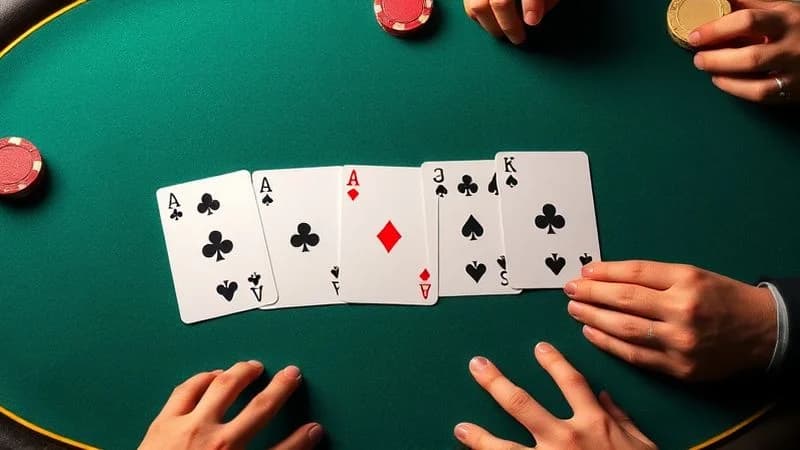
Multiway Hand Review: Donk Bet on a Wet Board Calls for Careful Play
A $600 regional mini-high roller hand featuring a multiway donk bet on a wet K♥5♥6♣ flop. Hero in the big blind with 5♠5♦ faces decisions against a solid HJ and a fishy SB, leading to a tricky turn and river jam.
The Best Way to Learn Poker Long-Term: A Systematic Path from Mathematics to Practical Play
From beginner to advanced, long-term improvement in poker requires systematic learning of math fundamentals, range construction, and GTO strategy, combined with practical review and professional content. This article summarizes community experience and provides a sustainable path to progress.

Facing an OMC's Cold 3-Bet and Calling Leads to a Multiway Pot, How to Respond?
A player encounters a rare situation in a $5/$5 cash game: an old man coffee OMC who has never 3-bet before makes a cold 3-bet preflop, and calling almost certainly results in a multiway pot. The article analyzes OMC's range characteristics and discusses reasonable settings for 4-bet, call, and fold ranges, taking into account postflop position and pot control.

Why Not Call Weak Hands vs 3-Bet Preflop?
In Texas Hold'em, calling weak hands against a 3-bet preflop is often a source of long-term losses. This article analyzes common calling mistakes, the underlying math, and better strategies like folding or 4-betting to help players avoid common pitfalls.

Paired Board Complete Strategy Guide
In-depth analysis of the definition, principles, and strategy adjustments for preflop, flop, turn, and river on paired boards, covering real-world examples and common misconceptions to help you make optimal decisions when the board pairs.

Final Table Hyper Turbo Strategy Guide
In Hyper Turbo tournaments, the final table strategy is drastically different from regular events due to extremely short blind levels and elevated pot odds. This article delves into core principles, hand range adjustments, push/fold decisions, and common mistakes to help you make better decisions in these fast-paced situations.
Related
Range Bet Turn
A continuation bet made on the turn with a very high frequency often 100% of one's range, typically in positions where …
GlossaryMiddle of Range
The set of hands in a player's range that are neither the strongest top of range nor the weakest bottom of range, typic…
GlossaryTop of Range
The strongest hand or hands within a player's range of possible holdings in a given situation.
GlossaryUncapped Range Advantage
Uncapped Range Advantage refers to the strategic edge a player holds when their range contains the strongest possible h…
GlossaryValue Heavy Range
A range of hands that contains predominantly strong value hands with very few or no bluffs, indicating the player is li…
GlossaryRange Advantage Turn
The strategic edge a player holds on the turn because their overall hand range is stronger than the opponent's, often d…
GlossaryRange Morph
Range Morph is the strategic adjustment of a player's hand range to an opponent, often to exploit perceived weaknesses …
GlossaryCondensed Range
A range composed primarily of medium-strength hands with similar equity, lacking clear polarization between very strong…